

Something fundamental has shifted in how Americans think about building a home. The sprawling houses of the early 2000s are giving way to intentional, smaller spaces designed around how people actually live.
Today, buyers prioritize efficiency, flexibility, and long-term value over sheer size. The result is a new generation of functional, durable custom homes that work harder and cost less to maintain. Whether you are exploring custom home building from scratch or seeking inspiration, this guide breaks down the essential new home building trends worth incorporating into your next project.
New Home Building Trends
Homeowners are abandoning the giant layouts of the past for smarter, intentional spaces. Data from the National Association of Home Builders (NAHB) proves this shift. In 2023, the average new single-family home dropped to 2,411 square feet, the smallest in 13 years. Buyers now prioritize daily utility and long-term efficiency over raw square footage.
Flexible floor plans and multi-use spaces
The open floor plan isn’t disappearing; it’s evolving into a more thoughtful and functional design. Today’s layouts balance openness with intentional zoning, using subtle architectural cues like double-sided fireplaces, half-walls, and varied ceiling heights to define distinct areas. As Builder Online puts it, open-concept design is “evolving to include more separation and functionality to suit modern lifestyles”.
Driving this shift are hybrid work and multigenerational living. Remote workers need dedicated office space, while families housing aging parents or adult children require layouts that offer privacy.
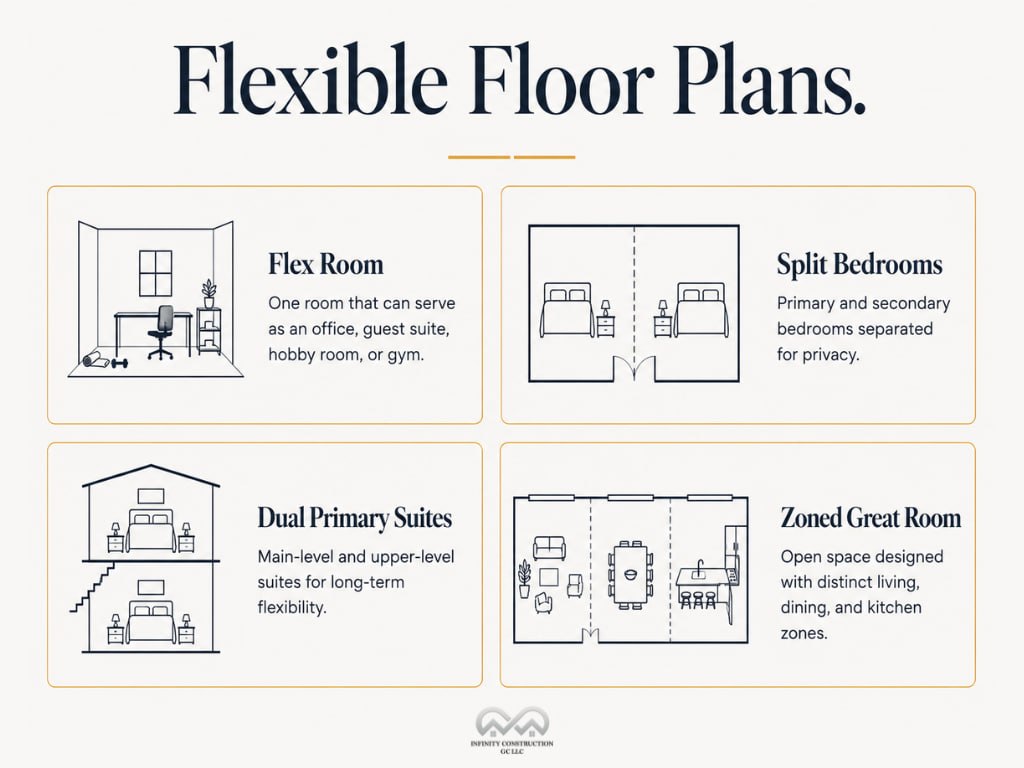
The most forward-thinking floor plans account for this with:
- Flex rooms – Serve as an office, guest suite, hobby room, or gym depending on your life stage.
- Split-bedroom designs – Place the primary suite on one side and secondary bedrooms on the other to maximize privacy.
- Dual primary suites – Feature one suite on the main level for accessibility and one upstairs for long-term planning.
- Zoned great rooms – Feel completely open but function as distinct living, dining, and kitchen areas.
The best floor plans don’t just work for today; they adapt gracefully as your household changes.
Smaller, more efficient home design
Right-sizing is replacing oversizing as the defining mindset in new home construction. In 2025, half of all house plans sold ranged from 1,000 to 1,999 square feet, up from 48% the year prior. This reflects a deliberate buyer preference for smarter homes, not just larger ones.
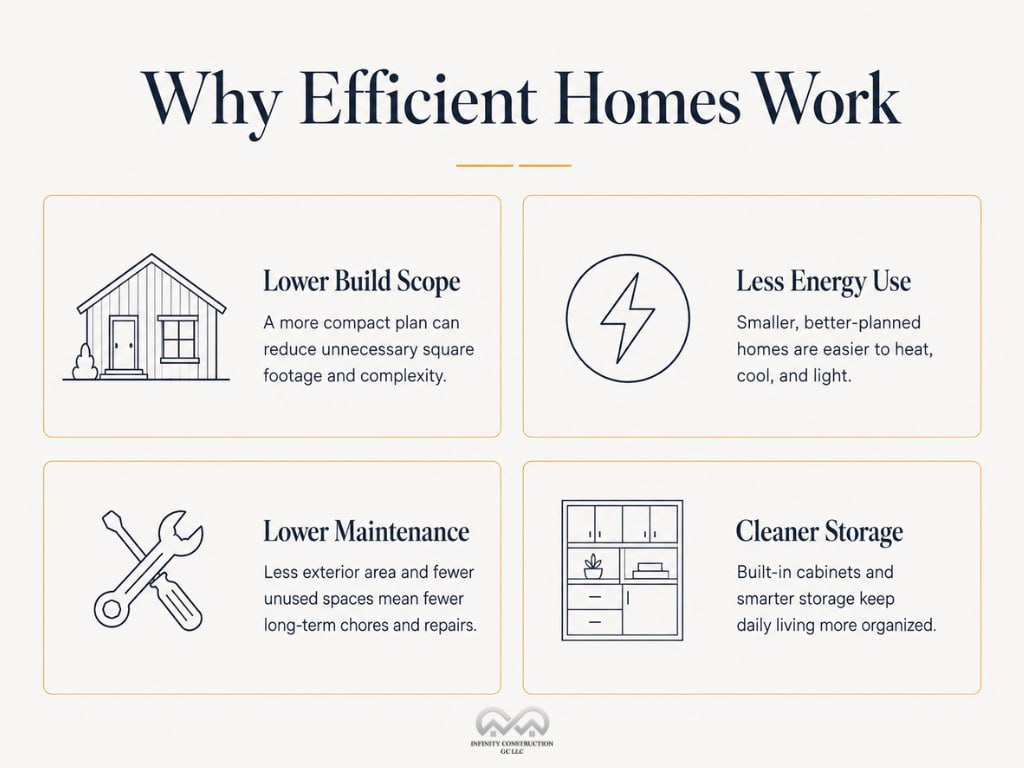
A smaller, well-designed home offers real advantages:
- Lower construction costs per project, which means more budget available for high-quality finishes and materials
- Reduced energy consumption through less square footage to heat and cool
- Lower long-term maintenance costs and time commitment
- Cleaner, less cluttered living through intentional storage and layout design
Smaller doesn’t mean cramped. Thoughtful design choices, like vaulted ceilings, large windows, seamless indoor-outdoor connections, and smart built-in storage, make a 1,500-square-foot home feel open and airy. Even D.R. Horton, America’s largest homebuilder, successfully reduced its average home size to capture this growing market appetite for efficient homes.
The takeaway is that square footage is no longer the primary measure of a dream home; the smarter question is what your lot can realistically support.
Covered outdoor living spaces
The outdoor living trend is becoming more sophisticated. Simple patios have evolved into covered, fully designed extensions of the home’s interior. Equipped with structural roofing, ceiling fans, heaters, and weatherproof materials, they allow for year-round use.
Today’s most desirable setups require careful structural planning for large roof spans, drainage, and utility connections during the design phase. According to the 2024 Houzz U.S. Outdoor Trends Study, 88% of homeowners install a grill during exterior renovations, with the majority adding a secondary cooking method.
These desirable outdoor living setups include:
- Covered patios and porches with structural framing for ceiling fixtures, fans, and heaters
- Outdoor kitchens with prep stations, grills, pizza ovens, smokers, and Argentine-style gaucho grills
- Screened porches and living rooms with comfortable, performance-fabric furnishings rivaling interior spaces
- Wraparound porches creating distinct zones for morning coffee, dining, and lounging
Energy-efficient and durable building materials
Material selection is a high-leverage decision in a new home build. Choosing well reduces energy costs, maintenance headaches, and replacement cycles for decades. Materials trending right now reflect a clear priority: performance over appearance alone.
The Green & Resilient Single-Family Homes 2024 report found that nearly 22% of homebuilders reported 90% or more of their 2023 projects met strict green building criteria. This signals sustainability is a mainstream construction standard, not a niche upgrade.
Materials leading the field include:
- High-performance windows – Triple-pane, low-E, argon-filled units outperforming standard double-pane glass in insulation and heat management
- Fiber cement and engineered wood siding – Dimensionally stable, moisture-resistant, and more durable than wood in harsh climates
- Spray foam and continuous rigid insulation – Eliminates thermal bridging and air infiltration better than batt insulation, especially when paired with advanced framing methods
- Metal roofing – Lasts 40-70 years (versus 20-25 for asphalt) with superior wind, hail, and fire resistance
- Porcelain surfaces – Heat-resistant, low-silica quartz alternative with outdoor durability
- Reclaimed & sustainable wood – Structurally superior to new-growth lumber with strong aesthetic and environmental value
ADUs and multigenerational living
Accessory dwelling units (ADUs) have moved from zoning curiosity to a mainstream custom home feature, especially as more homeowners research ADU size rules in Washington. An ADU is a self-contained living space on the same property as a primary residence. Cities are responding to housing supply pressures. For example, Bend, Oregon updated regulations to allow two ADUs per property with pre-approved designs to streamline permitting.
According to Forbes, multigenerational living increasingly influences modern home design, with families focusing on flexible layouts and ADUs that can even be sold separately. Multigenerational design also applies to the main structure. Dual primary suites, one on the main level with aging-in-place accessibility, one upstairs, appear in a growing share of new floor plans.
These flexible assets and setups include:
- Detached cottages, converted garages, or above-garage apartments for guests or aging parents
- Rental properties that generate income and offset mortgage costs
- Flexible spaces that can evolve from guest houses to caregiver suites or rentals
- Dual primary suites with accessible main-level features alongside an upstairs suite
Larger windows and natural light
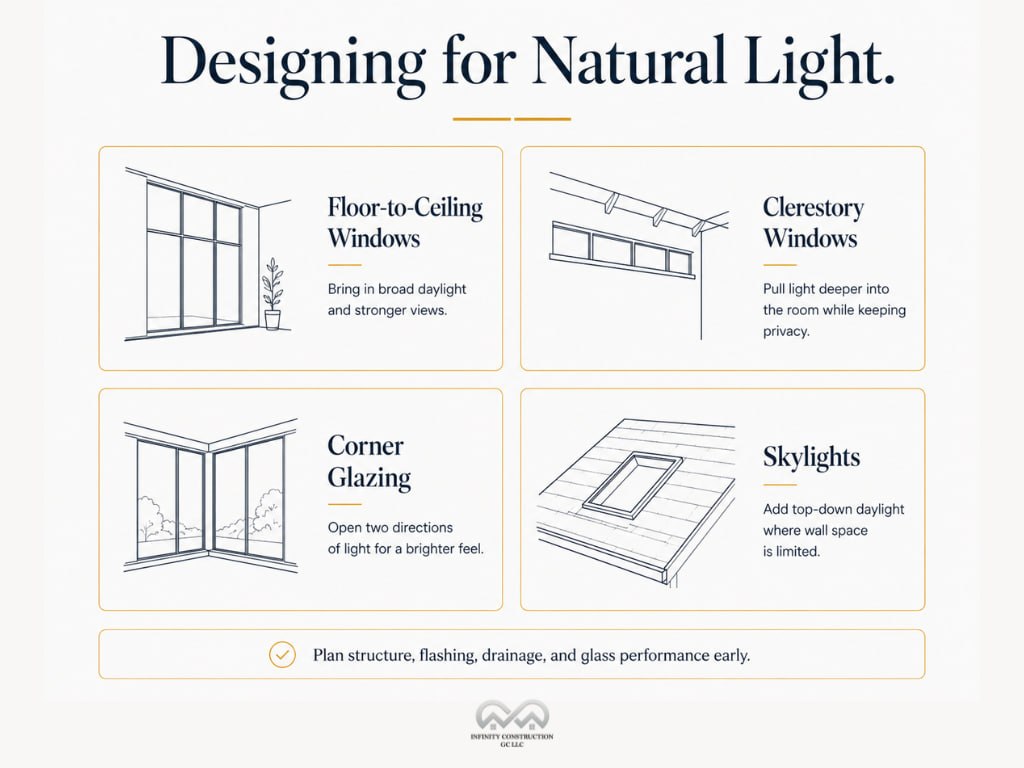
Natural light is a top priority in custom home design because it regulates circadian rhythms, boosts mood, reduces artificial lighting needs, and makes spaces feel larger. Builders are creating window packages that treat views as a primary architectural feature. By incorporating floor-to-ceiling windows, clerestory windows, corner glazing, and strategic skylights, they bring daylight deep into floor plans that would otherwise rely on artificial illumination.
From a construction standpoint, larger window openings require careful structural planning during the design phase and must account for Washington building code requirements. Headers must be properly sized to transfer structural loads, while larger glass units require appropriate framing, advanced flashing, and robust sill drainage to prevent water infiltration.
Additionally, high-specification glass, which utilizes performance coatings, gas fills, and durable frame materials, is essential to maintain thermal insulation and long-term durability. Addressing these critical engineering details early is far less expensive than fixing failures after the fact.
New Home Building Trends That Add Long-Term Value
Not every trend adds lasting value, as some aesthetic moments date quickly. The features worth building in improve livability, reduce operating costs, or expand functional flexibility over time. The National Association of Realtors consistently finds that buyers place a premium on energy efficiency, flexible layouts, and outdoor living features. Building these elements in from the start is almost always more cost-effective than adding them later. Before committing to these upgrades, use our questions to ask before hiring a builder guide to confirm whether your contractor can price, phase, and execute them properly.
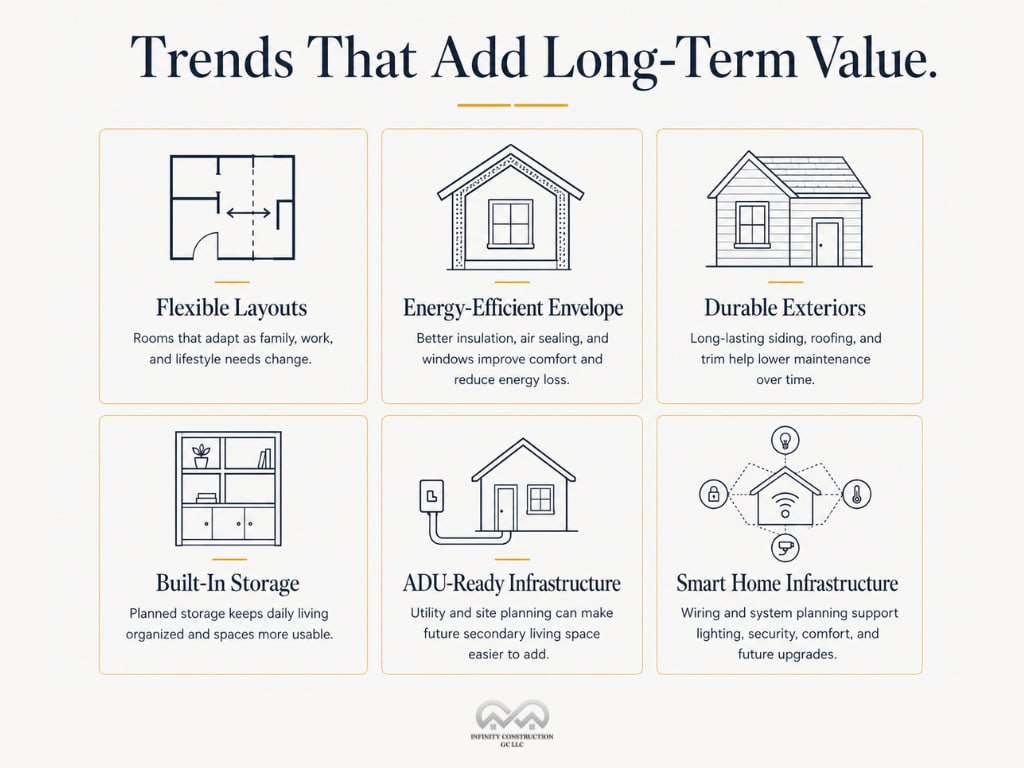
The highest-ROI features in today’s custom homes include:
- Flexible layouts – Accommodate changing household needs without requiring structural modifications.
- Energy-efficient building envelopes – Advanced insulation, windows, and air sealing that permanently reduce monthly utility costs.
- Durable, low-maintenance exteriors – High-performance materials that minimize upkeep and replacement costs over decades.
- Dedicated, well-designed storage – Integrated mudrooms, pantries, and built-ins that optimize daily living functionality.
- ADUs or ADU-ready infrastructure – Stubbed utilities and permit-ready plans that preserve options for future income or multigenerational use.
- Smart home infrastructure – Conduit runs, structured wiring, and extra panel capacity installed during construction to enable seamless future technology upgrades without invasive retrofitting.
Home Building Trends That Can Increase Construction Costs
Transparency matters here. Several of the most popular current trends carry real cost implications worth planning for explicitly. Prioritizing these features during the design phase allows them to be built in efficiently rather than retrofitted expensively.
The trends with the highest construction cost implications include:
- Large glass wall systems – Multi-slide door units can cost $15,000-$30,000+ and require expensive structural headers, prepared floor tracks, and specialized drainage.
- Complex rooflines – Multiple gables, mixed pitches, and dramatic overhangs add material, labor, and flashing complexity that quickly compounds expenses.
- Large open spans – Eliminating intermediate support walls requires engineered beam systems, like LVL, steel, or glulam, that cost significantly more than standard framing.
- Advanced smart home systems – Fully integrated platforms unifying lighting, HVAC, security, shading, and audio can run $20,000-$80,000+ for a custom home.
- Wellness features – Residential saunas, steam showers, cold plunge installations, and circadian lighting systems add $5,000-$50,000+ depending on specifications.

Conclusion
The new home building trends defining 2026 prioritize functional performance over listing-photo aesthetics. High-ROI features like smaller footprints, flexible spaces, durable materials, year-round outdoor areas, and ADUs improve daily life while protecting long-term investment value. These are lasting structural choices, not passing fads.
Locking in these features during preconstruction planning is critical for aligning your layout, materials, and systems with your budget. Changes on paper cost almost nothing, but modifications made after wood framing begins grow exponentially more expensive and can disrupt the entire custom home build timeline. When exploring a custom home build, prioritize practical trends that match your lifestyle and long-term goals over those that just photograph well.