

Planning a custom home project starts with understanding how much space a piece of land can realistically support. This can be explored through simple math using measurements, proportions, and limits such as lot size and required open space.
Estimating what is a good lot size for a home involves more than basic multiplication. Zoning rules, easements, land shape, septic requirements, and required setbacks all affect how much of the property can actually be built on, turning rough ideas into clearer, practical numbers.
In the following, you’ll discover how to use the lot calculator, where it falls short, and which real-world constraints actually determine how much you can build. Learning what size house will fit on my lot calculator highlights how a simple approach can help shape realistic building expectations.
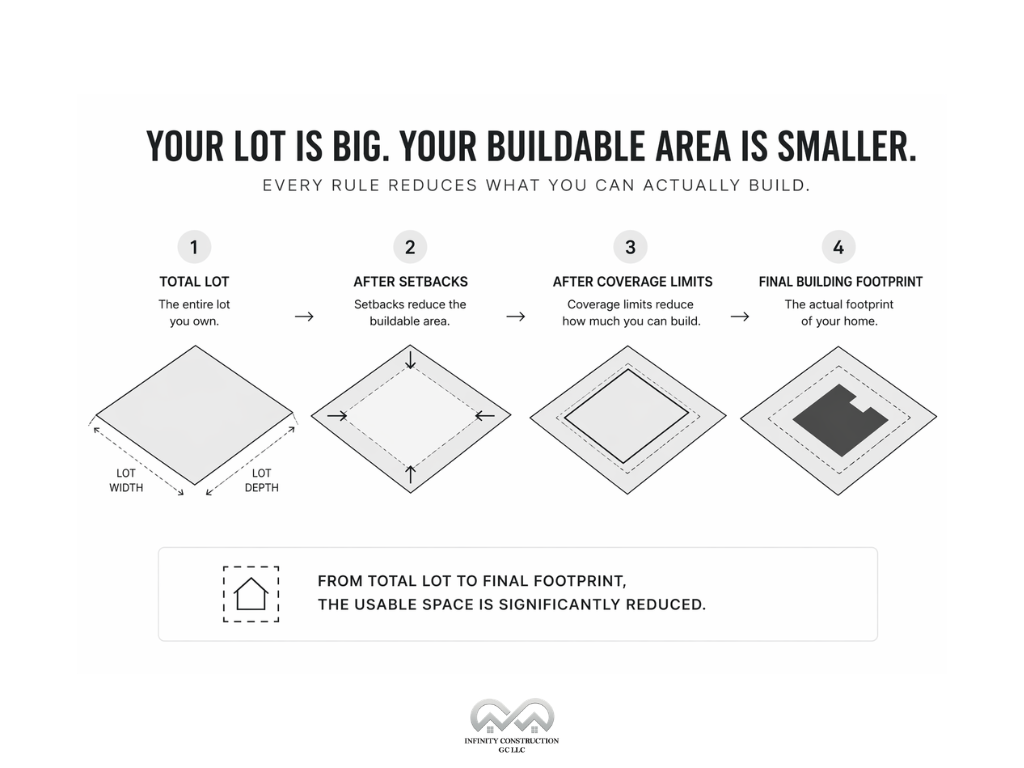
Use This Calculator to Estimate Your Buildable Area
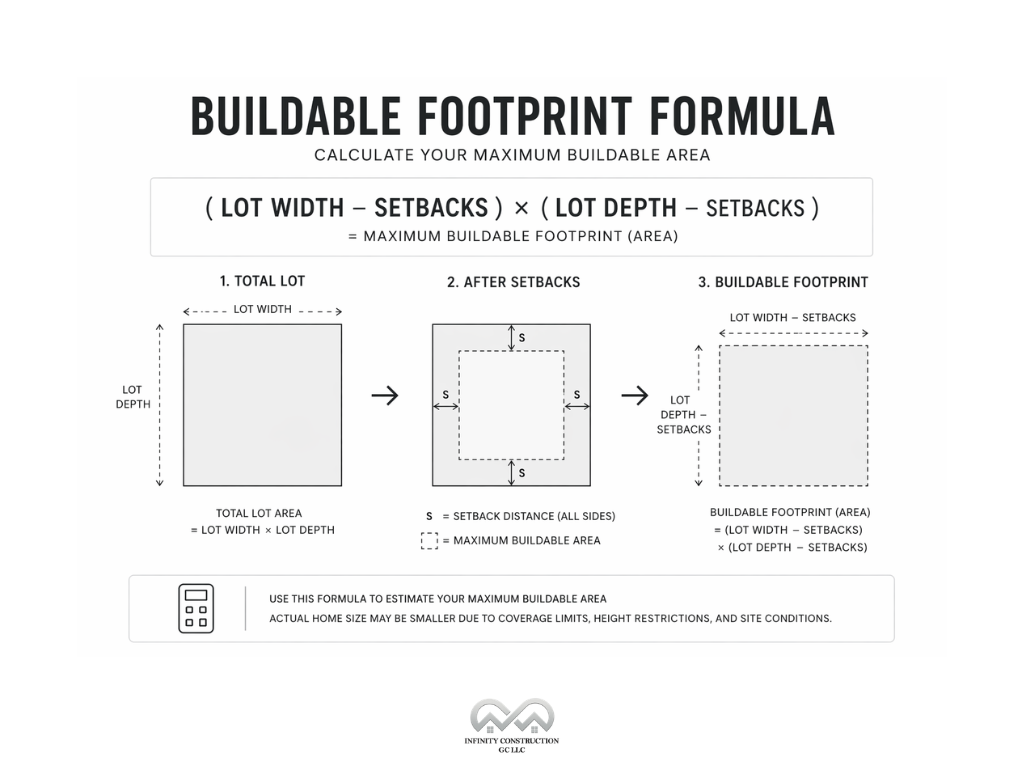
Before engaging a builder or architect, run the numbers yourself to find out what size house will fit on my lot calculator. The following quick estimator gives you a realistic starting point.
| Input | Value / Notes |
| Lot Size (sq ft) | Find on tax bill, deed, or county GIS/parcel map |
| Setback Buffer (all sides) | 10 ft is a common minimum; verify your local code |
| Lot Coverage % (typical range) | 25%-40% for most residential zones |
| Buildable Footprint (sq ft) | = (Lot Width – setbacks) × (Lot Depth – setbacks) |
| Realistic House Footprint | Buildable Footprint × Coverage % allowed |
Example: A 10,000 sq ft lot (100 ft × 100 ft) with 10 ft setbacks on all sides gives you an 80 ft × 80 ft buildable zone = 6,400 sq ft. If your zoning allows 35% lot coverage, your maximum ground-floor footprint is approximately 3,500 sq ft (35% of the total lot size of 10,000 sq ft). Since 3,500 sq ft fits within the 6,400 sq ft buildable zone, this is achievable. A two-story home on that footprint could total 7,000–7,500 sq ft of living space.
As a general reference, converting acres to square feet is straightforward – multiply by 43,560. For example, a quarter-acre lot equals 10,890 square feet, while a half-acre lot equals 21,780 square feet.
What Size House Will Fit on My Lot Calculator
Use this rough estimator to calculate how much house may fit on your lot based on lot size, estimated lot coverage, and optional setbacks. This is a planning tool only—not a substitute for zoning review, site analysis, or builder evaluation.
Why Most Lot Size Calculators Get It Wrong
Most online lot-to-home calculators share a critical flaw: they treat lot size as if it were equal to the buildable area. They ignore the real-world constraints that municipalities, counties, and states impose on residential construction. Here’s what they typically miss:
- Zoning setbacks – required distances from property lines that create a hard perimeter around your buildable zone
- Lot coverage limits – percentage caps on how much of a lot can be covered by impervious surfaces (home + driveway + outbuildings)
- Easements – utility corridors, drainage rights-of-way, or access strips that pass through your land and cannot be built on
- Septic system requirements – in unsewered areas, the drain field must be sized and located before a house footprint can be confirmed
- Environmental overlays – critical areas, wetland buffers, shoreline setbacks (especially relevant in Washington State)
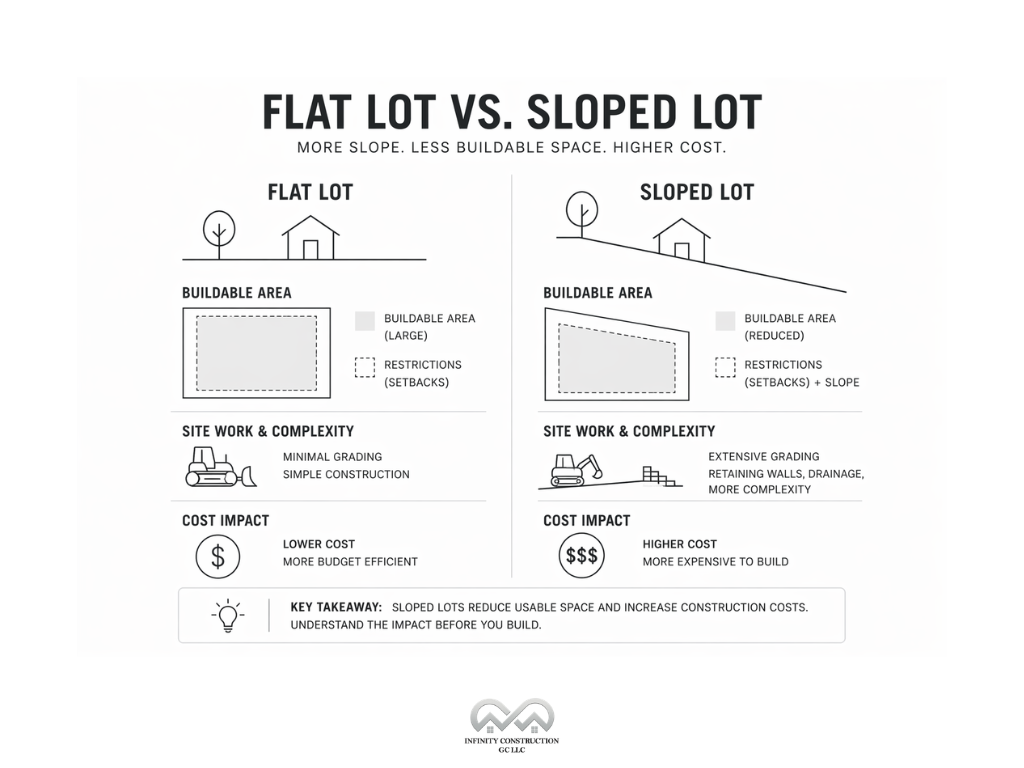
- Topography – a sloped lot dramatically reduces flat buildable area and can trigger additional engineering requirements
Using a basic calculator without the full context creates false confidence. The lot looks fine on paper, but once you review the zoning report in detail, you may find that a significant portion of the land isn’t actually unbuildable. This is exactly the situation a pre-purchase site evaluation is designed to prevent.
What Actually Limits How Big Your House Can Be
Setbacks – Front, side, and rear
Setbacks are mandatory buffer distances between your home and each property line. They are not equal; front yard setbacks are almost always larger than side or rear setbacks. A typical suburban lot might require a 20 feet front setback, 5 feet side setbacks, and a 15 feet rear setback. That alone removes a significant perimeter from your buildable area.
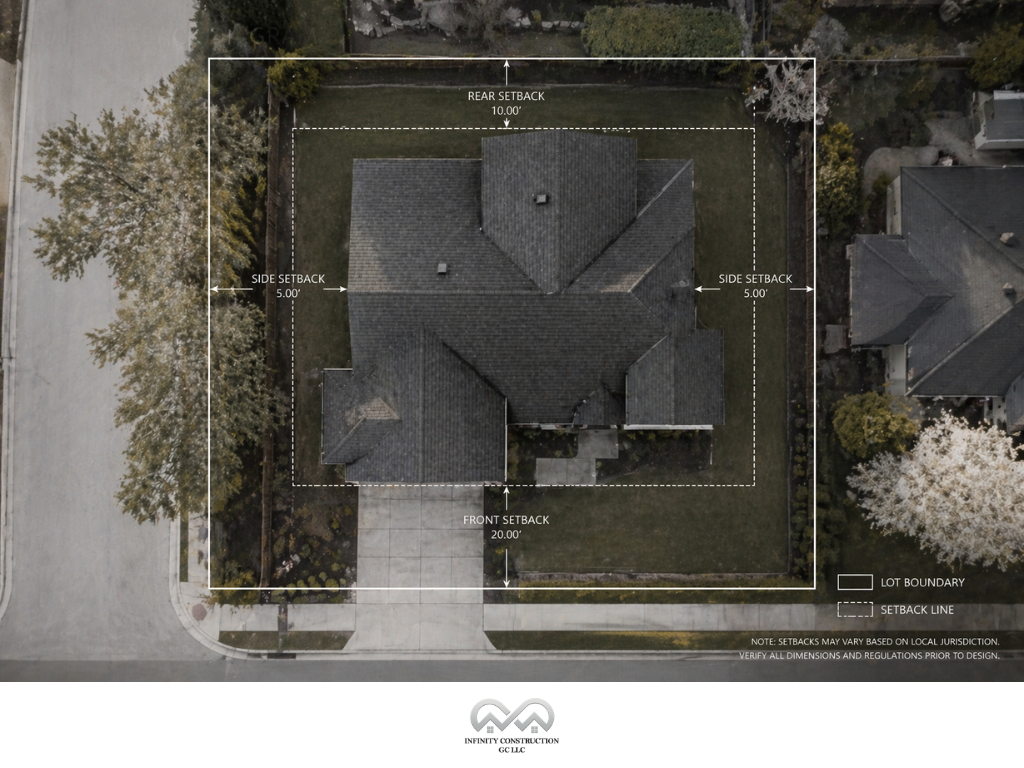
Setback requirements are set by local zoning ordinances and can vary dramatically by zone type (R1, R2, rural residential, etc.), municipality, and even the specific street. Always verify with your county’s planning department before assuming any number.
Lot coverage rules
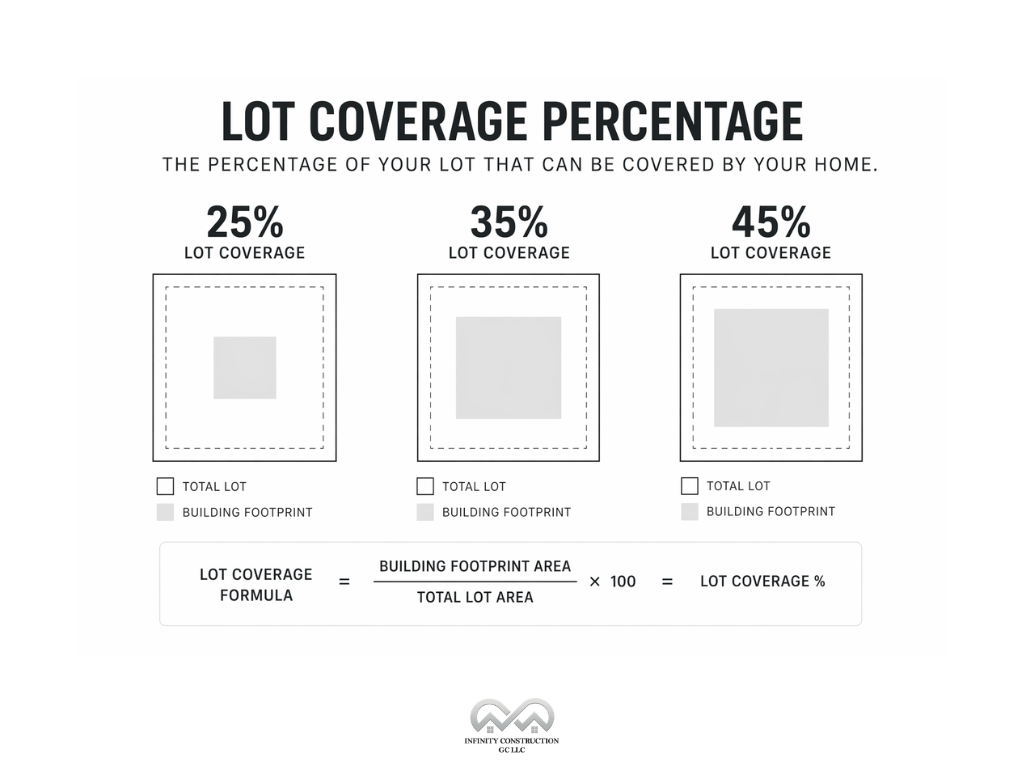
Most residential zones limit the percentage of a lot that can be covered by structures and impervious surfaces. This is separate from floor area ratio (FAR), which limits total square footage across all floors. Common residential lot coverage limits range from 25% to 45%. A 40% coverage limit on a 0.25-acre lot (10,890 square feet) caps your combined structure footprint at approximately 4,356 square feet, shared between the house, garage, patio, any outbuildings, and potential ADU size limits.
Easements – The invisible restrictions
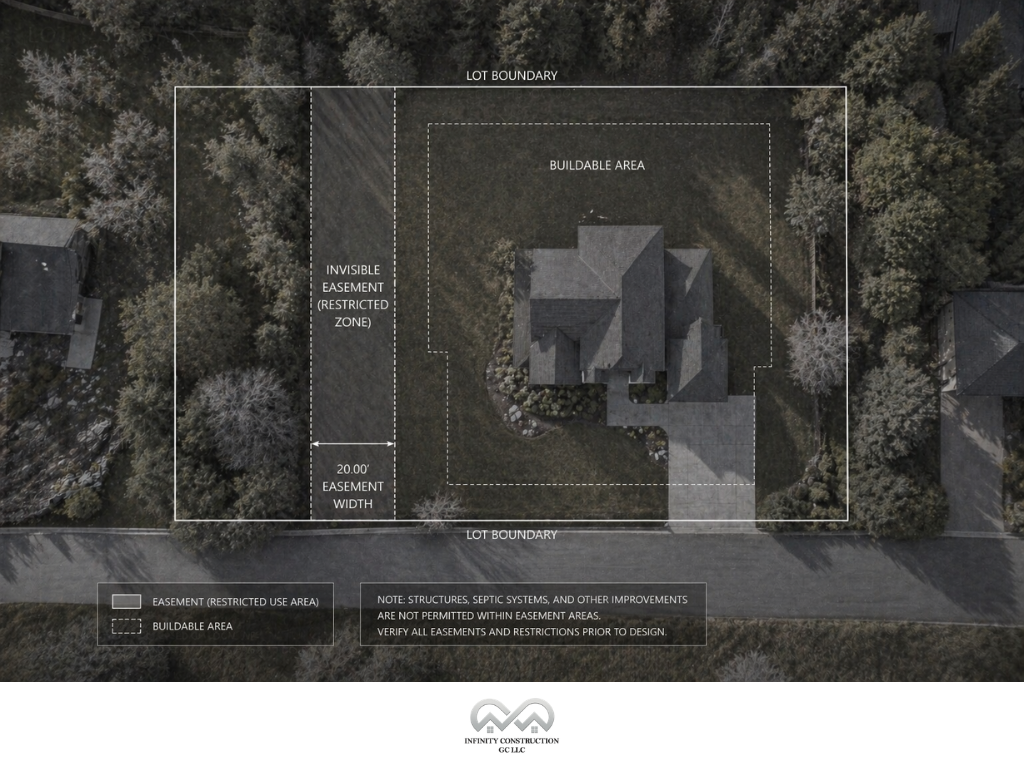
An easement grants another party the legal right to use a portion of your property for a specific purpose, such as utility lines, drainage, shared driveways, or public access paths are common examples. Easements run with the land and survive ownership changes. You may have no idea an easement exists until you review the title report. Building within an easement area can result in forced demolition and liability. So, you should always order a title search and review the property survey before finalizing a home design.
Septic systems – A major factor in rural Washington
In areas not served by municipal sewer, which includes vast portions of rural and semi-rural Washington State, a septic system is required. The drain field must be sized based on soil percolation tests and the number of bedrooms in the home. A three-bedroom home typically requires a drain field of 1,500-3,600 square feet, and it must be located a minimum distance from the home, well, property lines, and water features.
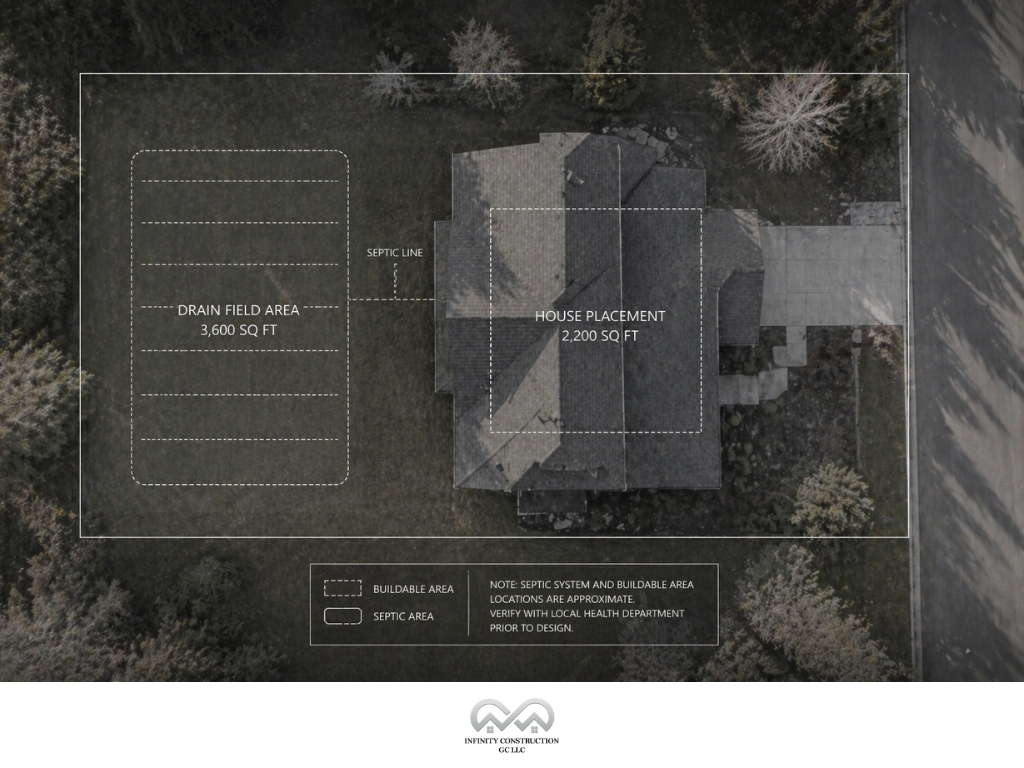
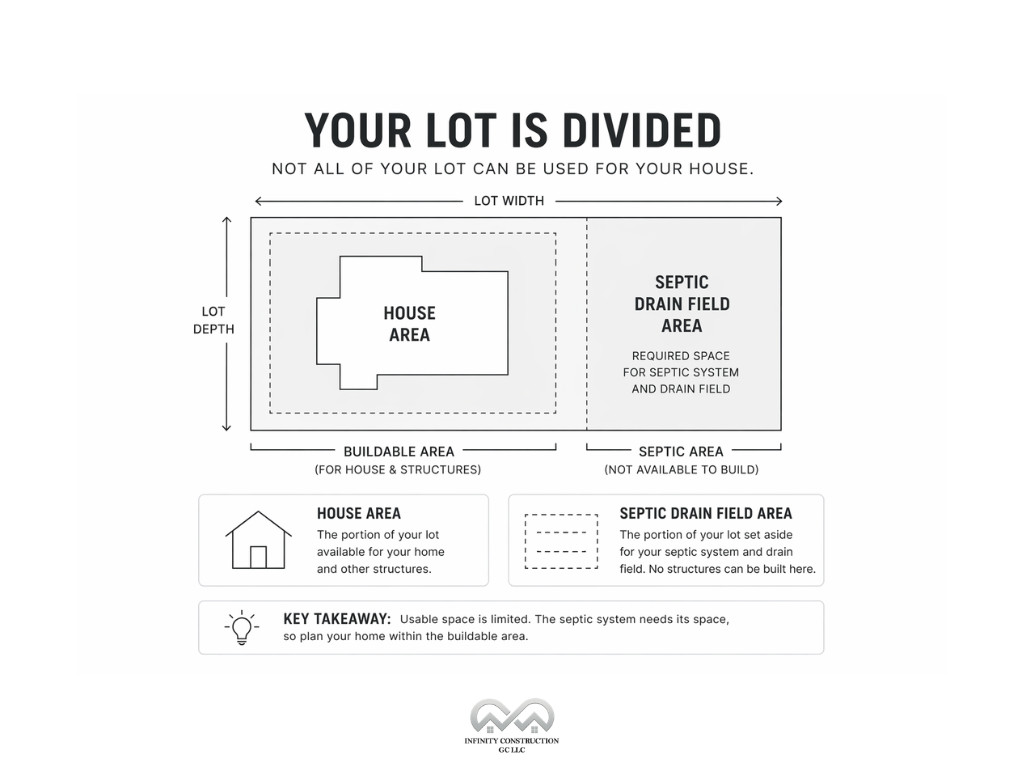
Your drain field can consume 15-30% of a standard suburban lot, and it must remain unbuilt, uncompacted, and unplanted with deep-root vegetation. In practical terms, a 10,000 square feet lot with septic requirements may have a buildable area under 5,000 square feet. Skipping a perc test before buying rural land is one of the most costly mistakes a buyer can make.
Slope and topography
A lot listed as 0.5 acres looks very different depending on whether it’s flat or hillside. Sloped parcels require grading, retaining walls, and engineered foundations, all of which cost significantly more than flat-site construction. More critically, usable buildable area is reduced because steep sections may fall under grading restrictions, drainage requirements, or geotechnical review mandates. In Washington, slopes exceeding 15-25% trigger additional critical area reviews in many jurisdictions.
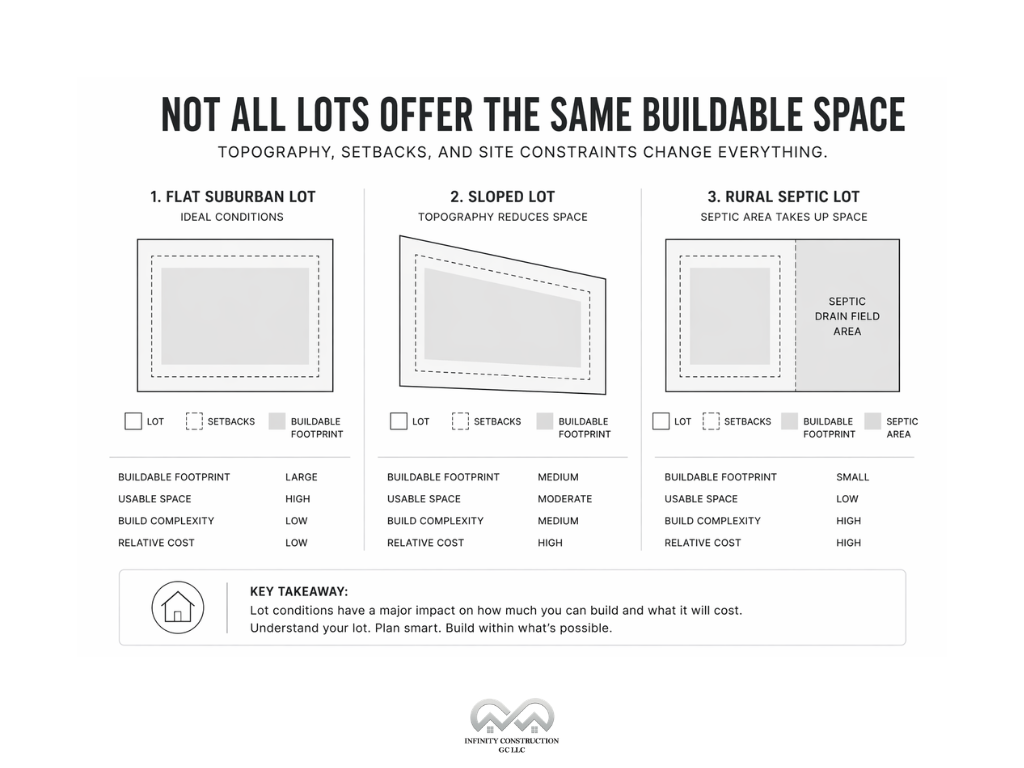
Real Examples – Same Lot Size, Very Different Outcomes
Example 1. Flat suburban lot (10,000 sq ft)
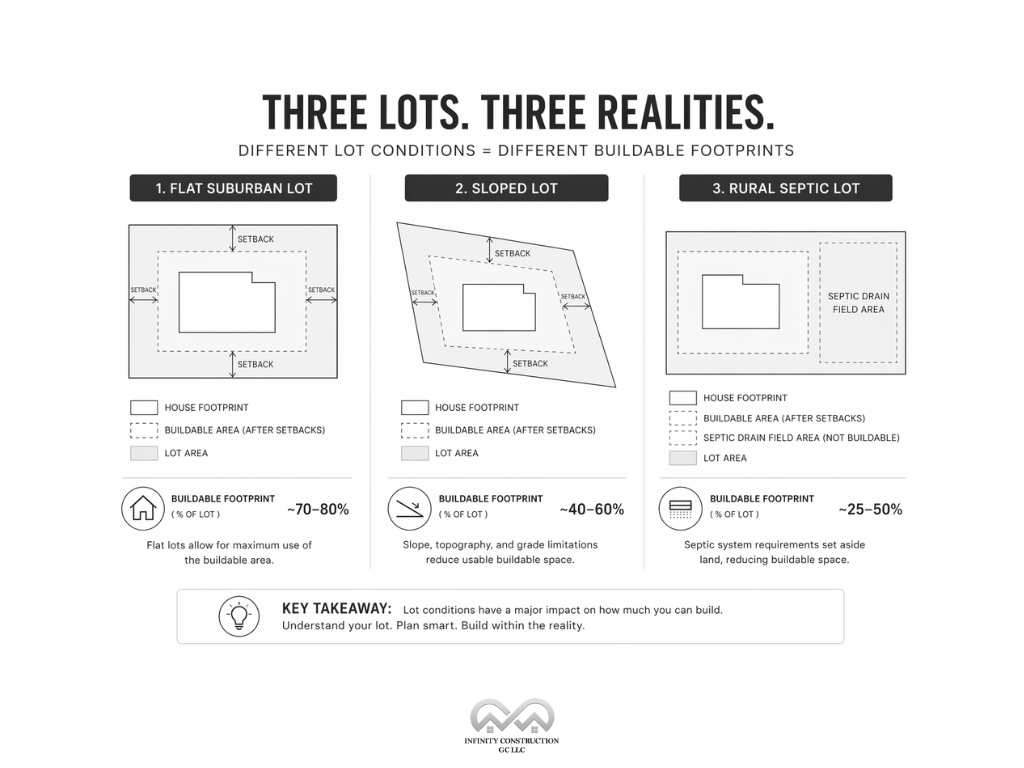
A standard suburban parcel of 10,000 square feet (roughly 0.23 acres) in a municipality with 20 feet front, 5 feet side, 15 feet rear setbacks, may allow a buildable envelope of roughly 5,500-6,000 square feet (depending on lot dimensions). However, with a 35% lot coverage limit, the maximum ground-floor footprint is about 3,500 square feet, which becomes the controlling constraint.
A well-designed two-story home can therefore reach 5,000-6,500 square feet of total living space. This is the scenario most online calculators assume, and it represents just one of several common site conditions.
Example 2. Sloped lot (10,000 sq ft)
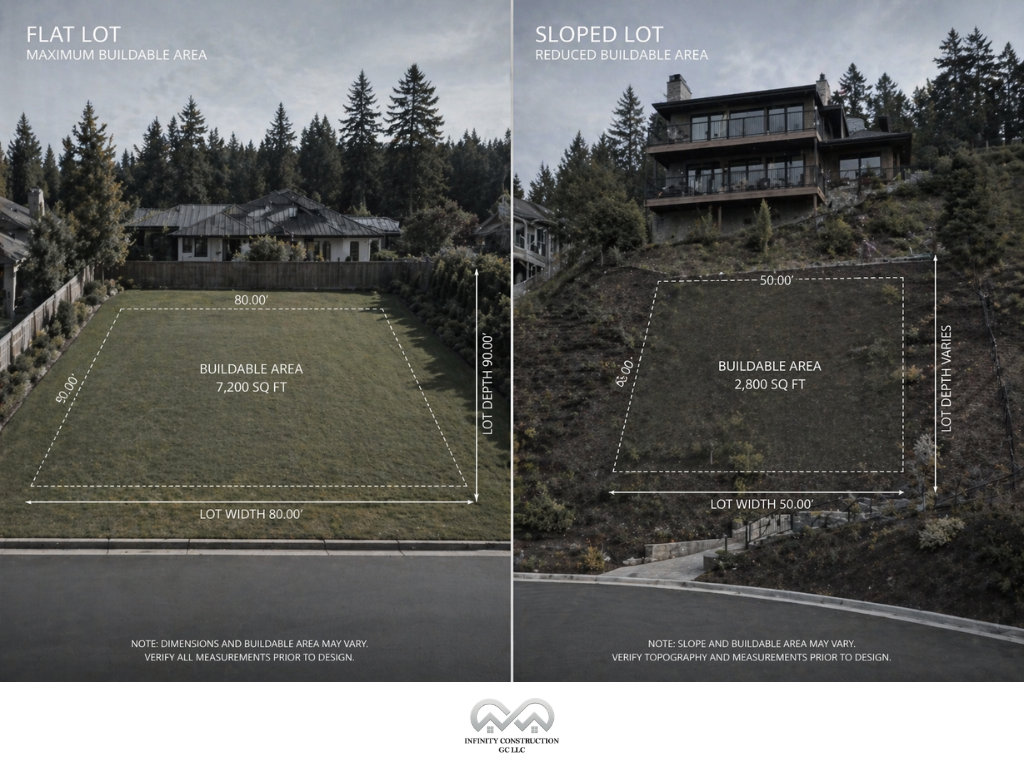
The same 10,000 square feet lot, but with a 20% grade across most of the parcel, reduces the practical flat buildable area due to grading complexity and foundation design. While setbacks and coverage limits still apply to the full lot area, the usable footprint is often smaller in practice.
A realistic home footprint here might be around 1,500-3,000 square feet, depending on design approach (e.g. stepped foundation or walk-out basement), rather than the maximum allowed on a flat lot.
Example 3. Rural lot with septic (21,780 sq ft / 0.5 acres)
A half-acre rural lot without sewer access might appear spacious, but the required drain field and its separation distances from the home, well, and property lines can reduce usable building area. Combined with typical rural setbacks (e.g. 20 feet front and 15-25 feet sides/rear), this can limit layot flexibility.
On this type of lot, a 2,000-3,000 square feet footprint is common, depending on system placement and soil conditions, rather than the larger sizes a basic calculator might suggest.
What is a good lot size for a home?
For most single-family homes in the United States, the most common lot size is approximately 0.2 acres (8,712 square feet), according to U.S. Census Bureau data on new residential construction. In American suburban settings, here are reliable general guidelines:
| Lot Size | Area Type | Typical Use |
| 0.1–0.15 acres (4,356–6,534 sq ft) | Dense urban | Townhomes, small single-family |
| 0.15–0.2 acres (6,534–8,712 sq ft) | Urban/inner suburban | Standard single-family, modest yard |
| 0.2–0.3 acres (8,712–13,068 sq ft) | Suburban | Comfortable single-family with yard |
| 0.3–0.5 acres (13,068–21,780 sq ft) | Outer suburban / semi-rural | Larger homes, gardens, outbuildings |
| 0.5+ acres (21,780+ sq ft) | Rural / acreage | Estate homes, hobby farms, septic lots |
Beyond the numbers, a good lot size is one that supports your intended home size after all constraints are applied, especially as more buyers prioritize smaller, more efficient homes. It should leave enough outdoor space for your lifestyle, whether that’s a flat lawn, a garden, a shop, or just breathing room between you and your neighbors.
Lot Size vs. House Size – What Actually Works
Here’s a practical reference table based on real zoning norms, average setback requirements, and standard lot coverage limits. These figures assume a flat lot with municipal sewer service and moderate setback requirements:
| Lot Size | Estimated Buildable Area | Realistic 1-Story Footprint | Realistic 2-Story Total |
| 6,000 sq ft (0.14 ac) | ~3,200 sq ft | Up to 1,200 sq ft | Up to 2,200 sq ft |
| 8,712 sq ft (0.2 ac) | ~4,800 sq ft | Up to 1,700 sq ft | Up to 3,200 sq ft |
| 10,890 sq ft (0.25 ac) | ~6,200 sq ft | Up to 2,200 sq ft | Up to 4,000 sq ft |
| 13,068 sq ft (0.3 ac) | ~7,800 sq ft | Up to 2,700 sq ft | Up to 5,000 sq ft |
| 21,780 sq ft (0.5 ac) | ~13,500 sq ft | Up to 3,000 sq ft | Up to 6,000+ sq ft |
| 43,560 sq ft (1 ac) | ~28,000 sq ft | Up to 5,000 sq ft | Up to 10,000+ sq ft |
Note: These figures are estimates using common setback and coverage assumptions. Your actual limits will depend on local zoning. Always verify with your jurisdiction’s planning department or a licensed general contractor before finalizing a design.
Washington State Factors That Change Everything
If you’re building in Washington State, especially in the greater Puget Sound region, rural King or Pierce County, or anywhere near a shoreline, wetland, or steep slope, the standard rules mentioned above are only the beginning. Washington layers additional regulations on top of local zoning that can dramatically alter what’s buildable.
Zoning variability across counties
Washington has no statewide residential zoning code. Each of the state’s 39 counties and 281 incorporated cities sets its own rules. A lot in unincorporated Snohomish County can have completely different setback requirements, coverage limits, and height restrictions than an adjacent lot just inside city limits. Rural zone designations in Washington often carry minimum lot sizes of five or 10 acres, with home size restrictions to match.
Puget Sound and Shoreline regulations
Properties within 200 feet of a Shoreline of Statewide Significance, which includes Puget Sound, Lake Washington, and major rivers, fall under the Washington Shoreline Management Act. These properties face additional setback requirements (commonly 50-200 feet from the ordinary high water mark), vegetation retention rules, and in some cases, outright development prohibitions. A waterfront lot with a 200 feet shoreline setback and standard side/rear setbacks may have a buildable area of just a few thousand square feet, even on a large parcel.
Critical areas and environmental limits
Washington’s Growth Management Act (GMA) requires all counties to designate and protect critical areas like wetlands, fish and wildlife habitat conservation areas, geologically hazardous areas, flood hazard areas, and critical aquifer recharge areas. Development within or adjacent to these areas requires environmental review, mitigation, and often a substantial buffer of around 50 to 300 feet depending on the wetland category and land use.
Permitting reality – Plan for delays
In Washington’s most active building markets, including King, Snohomish, Clark, and Spokane counties, permit review timelines for new residential construction commonly run 3-9 months. Environmental reviews, geotechnical assessments, and drainage plans can add months more. Factoring the permitting timeline into your project schedule is not optional; it’s essential.
When You Need a Builder to Evaluate Your Lot
Online calculators and reference tables are useful starting points. They are not a substitute for a site-specific evaluation, especially in these situations:
- You’re purchasing raw land and want to confirm it’s buildable before closing
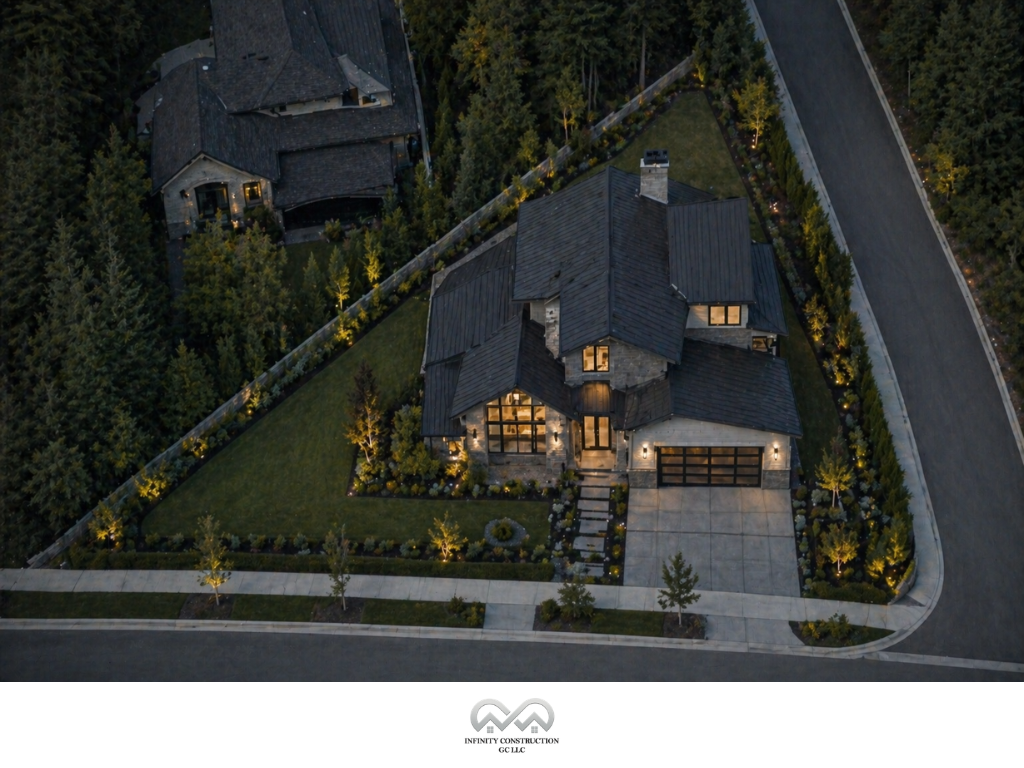
- The lot is irregular in shape (L-shaped, triangular, pie-shaped), and standard formulas don’t
- There are known or suspected environmental constraints (wetlands, slopes, old fill areas)
- You need septic system placement confirmed before finalizing a floor plan or planning a secondary dwelling
- You’re planning a large or complex home and want to maximize buildable area
- The lot is in a shoreline environment or critical area under Washington State jurisdiction
- You’re considering a knockdown-rebuild and need to confirm new construction compliance
A licensed general contractor or architect can conduct a preliminary site analysis, but you should know the right questions to ask before hiring a builder so you get real numbers, not estimates, for your specific parcel. This investment typically costs $500-$2,000 and can save tens of thousands of dollars in redesign costs later.
Conclusion
Every lot is different, so using a planning checklist can help you organize zoning, site conditions, budget, and design constraints before moving forward. The only way to know with certainty what you can build and how to maximize your property is to evaluate it through both a construction and regulatory lens. Looking at what size house will fit on my lot calculator is really about simplifying bigger figures into clear, usable insights. However, it won’t account for the real-world constraints that determine what’s actually possible.
At Infinity Construction GC, we provide site evaluations and pre-construction consultations for landowners and buyers throughout Washington State. We go beyond surface-level estimates by reviewing your parcel in detail, identifying zoning and site limitations, and giving you a clear, realistic picture of your buildable options before you commit to a design or break ground.