

Building a custom home should feel exciting, but many homeowners face a stressful collision with delays, unexpected change orders, and creeping budgets. These costly headaches rarely happen by accident. Instead, they stem from small, overlooked decisions made during the initial planning stages that quickly snowball once construction begins.
The biggest errors happen in the hidden parts of the project that people simply don’t see coming. This guide walks through the specific pitfalls that cause the most financial pain and outlines the exact home building mistakes to avoid to keep your project on schedule and on budget.
Home Building Mistakes to Avoid
One of the biggest reasons home-building projects run into trouble is that many costly mistakes occur long before move-in. Poor planning, unrealistic budgets, rushed decisions, and overlooked inspections can lead to delays, unexpected expenses, and long-term performance issues. The following breaks down how to avoid common home building mistakes and prevent them from ruining your budget or timeline.
Choosing the wrong builder
Almost every downstream problem in a custom build traces back to this one decision. Hiring based purely on the lowest bid, skipping a check of local experience, or signing a vague contract sets the tone for everything that follows.
Watch for these red flags:
- A bid that’s noticeably lower than every other quote, with no clear explanation
- No track record of custom builds in your specific area or lot type
- Slow or unclear communication before you’ve even signed anything
- A contract that doesn’t spell out allowances, timelines, and change-order pricing
- No structured process for design, selections, and construction phases
- Vague answers when you ask questions about cost overruns or delays
A builder who can clearly explain their process, show you completed local projects, and put timelines and costs in writing is doing more to protect your project than any single design decision you’ll make.
Skipping preconstruction planning
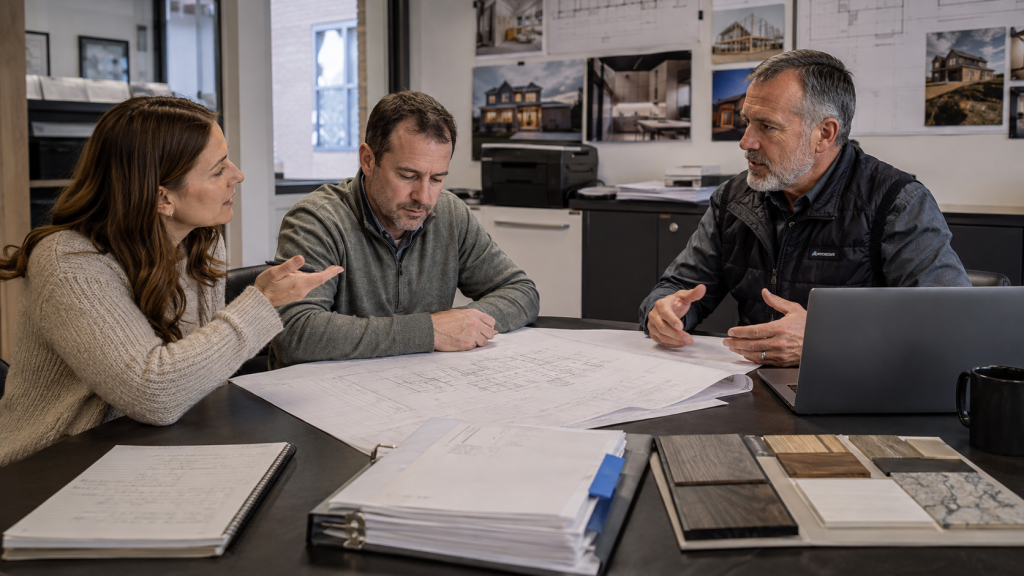
Breaking ground before design, budget, permits, and selections are actually aligned is one of the fastest ways to turn a clean project into a chaotic one. When the scope isn’t confirmed early, the construction schedule becomes a guess, and coordination between the design and build teams starts to break down the moment the first surprise shows up.
Avoid it by completing preconstruction before any digging starts, with final plans, a finalized budget, permits in hand, and major selections locked in. It feels slower on paper. It’s dramatically faster in the field.
Underestimating the real budget
Most homeowners budget for the parts of the build they can picture, like framing, drywall, cabinets, and paint. Far fewer budget for the parts they can’t picture yet, including site prep, permits, utility connections, engineering, landscaping, and a genuine contingency fund.
Industry cost breakdowns consistently show that hard construction costs represent only 60-75% of the true all-in budget; land, permitting, financing, and fees make up the remainder. For a local benchmark, average home-building costs in Washington State can help you pressure-test whether your total-project budget is realistic.
Budget guidance worth following:
- Set aside 10-20% contingency for change orders and the unexpected
- Separate “construction cost” from “total project cost” in your own spreadsheet
- Get firm numbers on site prep, permits, and utility hookups before finalizing your budget
- Ask your builder directly what is, and isn’t, included in the base price
Ignoring the lot and site conditions
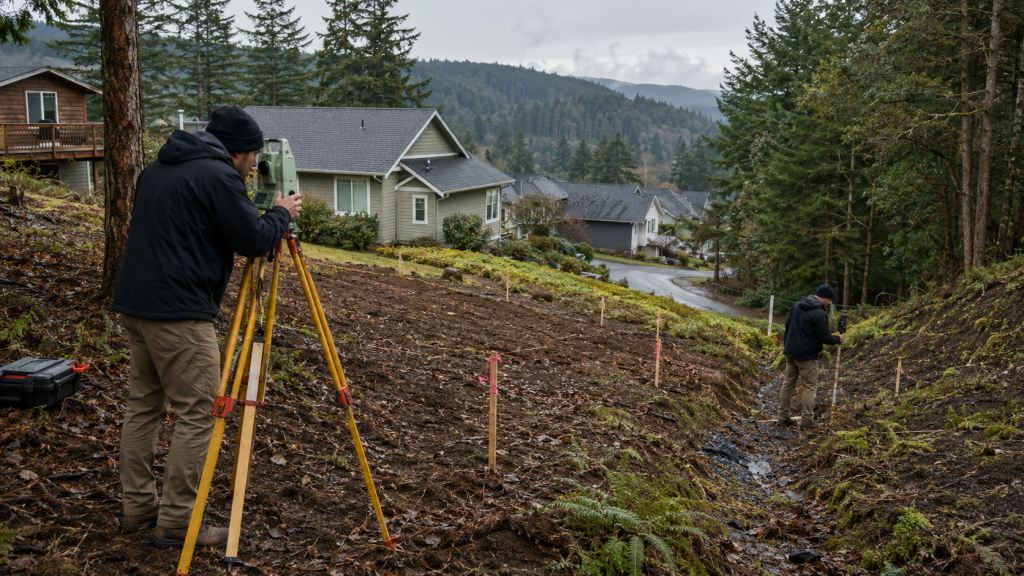
The land you build on can add tens of thousands of dollars to a project before a single wall goes up. Slope, drainage, soil composition, access, setbacks, tree clearing, grading, and septic or sewer requirements all affect cost and buildability, and they’re often the least understood part of the process for first-time custom home owners.
Order a soil survey and a full site evaluation before finalizing your budget, not after. A “great deal” on land with poor drainage or unstable soil rarely stays a great deal once engineering and excavation costs come in.
Not checking codes and permits early
Zoning restrictions, local building codes, permit timelines, inspection requirements, and energy code rules vary by jurisdiction, and sometimes by neighborhood.. If you’re planning an ADU or a smaller secondary structure, those rules can be even more specific.
Confirm zoning and permit requirements before you finalize a design, not after your architect has drawn it. Reworking a plan to satisfy a code requirement is far cheaper on paper than it is once permitting has already stalled your schedule.
Rushing the design phase
Design decisions made in a hurry tend to skip over how a family actually lives day to day: practical design must-haves like room flow, storage, natural light, future needs, and aging-in-place considerations all get shortchanged when the design phase is treated as a formality.
Changing a plan on paper is easier and cheaper than changing framing in the field. That single principle is worth more than almost any other tip in this guide.
Making late changes during construction
Moving a wall, swapping a window size, or changing a mechanical layout after construction has started doesn’t just cost money; it disrupts every trade scheduled after that point. A single late change order can ripple through electrical, plumbing, and framing schedules for weeks.
Lock in selections before they’re needed on-site, and treat any mid-construction change as a last resort, not a normal part of the process.
Choosing looks over function
A stunning kitchen island that blocks traffic flow. A mudroom that got cut to make room for a bigger pantry. A laundry room tucked somewhere inconvenient because it wasn’t a priority during design. These are some of the most common mistakes when building a custom home, and they’re rarely obvious until you’re actually living in the space.
Balance aesthetics against how each room will function on an ordinary Tuesday, not just how it photographs.
Overlooking framing quality
Framing decisions affect far more than the skeleton of your home; they influence long-term durability, insulation performance, layout flexibility, and structural alignment. Problems here are invisible once drywall goes up, which is exactly why they’re dangerous. Poor framing creates issues that show up years later as squeaks, drafts, or uneven floors, long after they’re cheap to fix.
Missing key inspection checkpoints
Every stage of a build has a checkpoint for a reason:
- Foundation inspection
- Framing inspection
- Rough-in inspection (electrical, plumbing, HVAC)
- Pre-drywall review
- Final inspection
Issues caught before walls are closed up cost a fraction of what they cost after. Treat every new-construction inspection as a genuine quality checkpoint, not paperwork to get through.
Ignoring energy efficiency and building envelope
Insulation, air sealing, window performance, moisture control, and ventilation determine how comfortable and how expensive your home is for decades after the builder leaves. These elements rarely make a design mood board, but they’re the difference between a home that’s comfortable in July and January alike, and one that isn’t.
How to Avoid Delays in Custom Home Building
If there’s one takeaway from every mistake above, it’s this – delays are almost always caused by decisions made too late, not by bad luck. To keep your timeline intact:
- Finish preconstruction completely before breaking ground
- Confirm permits and zoning early
- Understand your site conditions before finalizing your budget
- Lock in selections before they’re needed
- Avoid late design changes
- Schedule inspections properly and don’t rush past them
- Keep communication with your builder organized and documented
- Work with a builder who understands local codes and sequencing
Final Takeaway
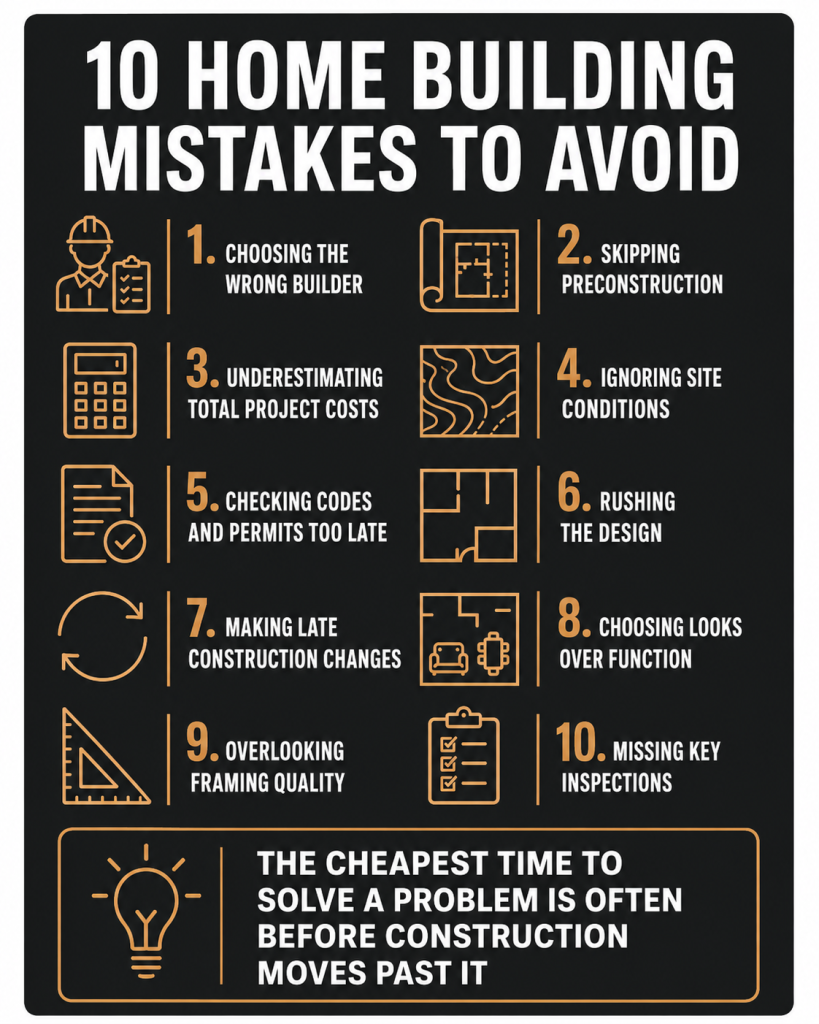
Home building mistakes to avoid are far easier to prevent than to fix after the fact. The most reliable way to stay on track is to plan early, choose the right builder, understand your site, respect the permitting process, and verify structural quality before finishes go in. None of these steps is complicated; they just require patience at the exact moments when it is tempting to rush.