

Building your dream house is one of the biggest investments you will ever make. It is an exciting journey that turns your unique vision into a physical space where your family can grow. However, the success of this massive project relies heavily on the professional team you select to bring your floor plans to life.
Finding the right partner requires careful research, clear communication, and a strict evaluation of past work. Learning how to choose a custom home builder will protect your budget and save you from unnecessary stress. This comprehensive guide outlines the essential steps to vet candidates, evaluate credentials, and select the perfect contractor for your project.
How to Choose a Custom Home Builder
Building a custom home is a major financial investment. Your project’s success depends entirely on the contractor you hire. The right professional turns your architectural design into a reality.
Avoid the common mistake of simply hiring the lowest bidder. Instead, protect your investment by prioritizing relevant custom-home experience, transparent pricing, and local site knowledge. Securing verifiable references and a detailed written contract ensures your project stays on track.
Here is a step-by-step guide to choosing the right partner for your build:
Start with your project needs
If you’re still defining the overall scope, planning the broader custom-home project first can help you establish the decisions a builder will need from you. Vague goals produce vague bids, and vague bids are where cost overruns start.
Nail down:
- Home size and architectural style (modern, craftsman, farmhouse, etc.)
- Realistic budget range, including a contingency buffer of 15-20%
- Lot status – Do you already own land, or are you buying a lot as part of the project?
- Location and any known zoning or HOA restrictions
- Timeline, including any hard deadlines (lease expiring, seasonal weather windows)
- Must-have features versus nice-to-haves
- Level of customization you actually want – fully custom from scratch, or a semi-custom base plan with personalized finishes
This step matters because it determines which builders are even worth calling. A builder who specializes in $250-per-square-foot production-style homes isn’t the right fit for a highly custom $500-per-square-foot project, and vice versa.
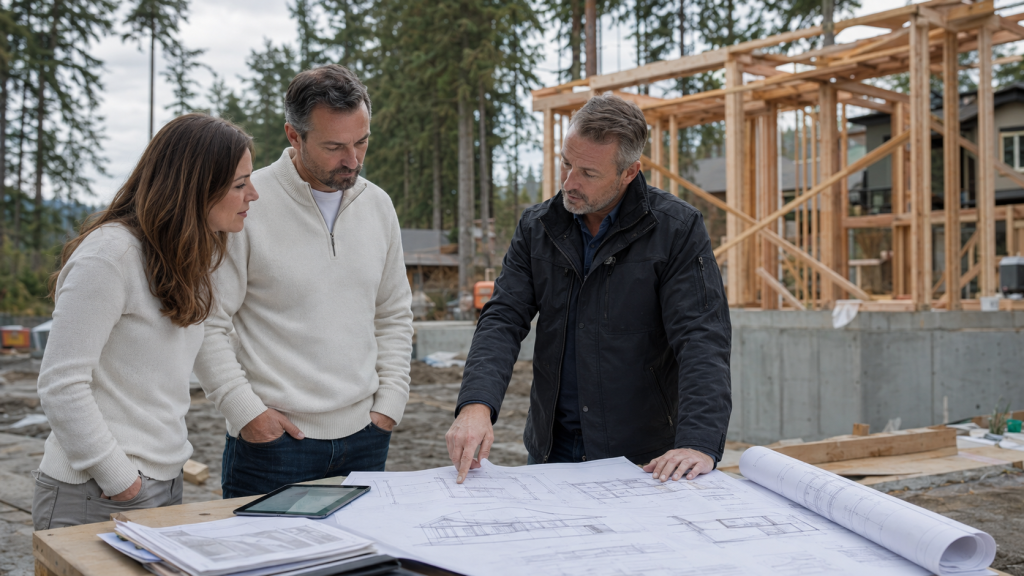
Look for relevant custom home experiences
Every builder claims to have “experience” in their marketing. What you actually need to evaluate is relevant experience, meaning builds that closely resemble your planned project. Ask each builder to show you homes of a similar size and budget range. Just as important is experience with similar lot conditions, like sloped, wooded, or waterfront properties, and a track record at your specific finish level. A builder used to standard materials may struggle with custom millwork or integrated systems.
Look for direct experience building from fully custom plans rather than modified stock designs. Always demand proof of completed projects. Photos alone are not enough, so ask for physical addresses you can drive by or tour. A builder with decades of general experience is rarely a better choice than a newer team that has built your exact type of home.
Check credentials, references, and reputation
Checking credentials, references, and reputation is a non-negotiable part of your due diligence. Skipping these checks often leads to unlicensed contractors, uninsured job sites, or builders who disappear mid-project.
Verify each of these before moving forward:
| What to Verify | Why It Matters |
| License status | Confirm with your state or local licensing board |
| Insurance | General liability and workers’ compensation – get certificates you can independently check |
| References | Gather them, and actually call them |
| Online reviews | Check multiple platforms, not just testimonials curated on the builder’s own website |
| Warranty support | Ask what’s covered, for how long, and who handles claims when something goes wrong |
| Reputation with local trades/vendors | Subcontractors and suppliers often know which builders pay on time and run organized job sites, and which ones don’t |
When you call references, ask pointed questions: Did the final cost match the original estimate? Were problems communicated proactively or did you have to chase updates? Would you hire this builder again for a second project?
Compare the process, not just the price
Comparing bids side by side without comparing what’s actually in each bid is the single most common mistake in custom home building.
Before ranking builders by price, compare bids across the same set of factors:
| What to Compare | Why It Matters |
| Scope of work | What’s explicitly included versus excluded from the number |
| Allowances | Placeholder budgets for flooring, fixtures, appliances, etc. – unrealistically low allowances make a bid look cheaper than it really is |
| Exclusions | Items quietly left out (landscaping, driveway paving, permits, utility hookups are common culprits) |
| Payment schedule | Whether draws are tied to completed milestones rather than arbitrary dates |
| Site work assumptions | Whether the bid reflects an actual assessment of your lot, or generic soil/drainage conditions |
| Change-order process | How price and schedule changes get documented and approved |
| Schedule | Whether it’s a real, phased timeline rather than a vague completion date |
| Job management | Who runs the project day-to-day – the owner, a dedicated project manager, or a rotating cast of subs |
A bid that’s 10% lower can easily turn into a project that’s 20% more expensive once change orders start piling up on top of unrealistic allowances. The cheapest number on paper is often the most expensive number by closing.
Make sure they understand local site conditions
A builder must understand how your local site conditions affect your actual build. In the Pacific Northwest specifically, a custom home builder needs a working understanding of:
- Moisture and drainage – Handling wet soil, stormwater management, and erosion control
- Site preparation – Managing slopes, grading, excavation, and building resilient foundations
- Logistics and access – Navigating driveway access, utility hookups, and local permitting timelines
Ask directly, “Which local authority handles permits here, and how long does approval usually take?”
An immediate, accurate answer proves the builder has real experience in your specific area. A builder who hesitates or needs to look it up likely lacks local knowledge.
Evaluate communication before you sign
How a builder communicates during the sales process is a preview of how they’ll communicate once you’re six figures into a signed contract.
Before you sign anything, clarify who your main point of contact is and whether that person will still be involved once construction starts. Ask how often you’ll receive updates and through what channel, be it email, a project management app, or a weekly call, and how decisions get tracked, since verbal agreements are worthless if a dispute comes up later.
It’s also worth asking how delays get explained (proactively, or only when you ask), how problems get documented, and how walkthrough and punch-list items get handled at the end of the project.
If a builder is slow to respond or vague during the sales process, when they’re actively trying to win your business, that pattern rarely improves once the contract is signed.
Review the contract and watch for red flags
The contract is where good intentions become enforceable terms. Before signing, make sure it clearly defines the scope of work and specifications, the allowances and exclusions, and a payment schedule tied to milestones rather than dates. It should also spell out the change-order process. This includes how pricing changes are calculated, along with warranty terms and owner responsibilities, things like decisions you’re expected to make, deadlines you’re on the hook for, and site access requirements.
Red flags that should make you pause or walk away entirely:
- Vague or verbal-only pricing with nothing in writing
- No written contract at all, or resistance to putting terms in writing
- Pressure to sign quickly, especially with “today only” pricing
- Inability or refusal to provide references
- Unclear or unverifiable insurance coverage
- No defined change-order process
- A bid that’s unusually low with no explanation for the gap
Any one of these alone might have an innocent explanation. Two or more together is a strong signal to keep looking.
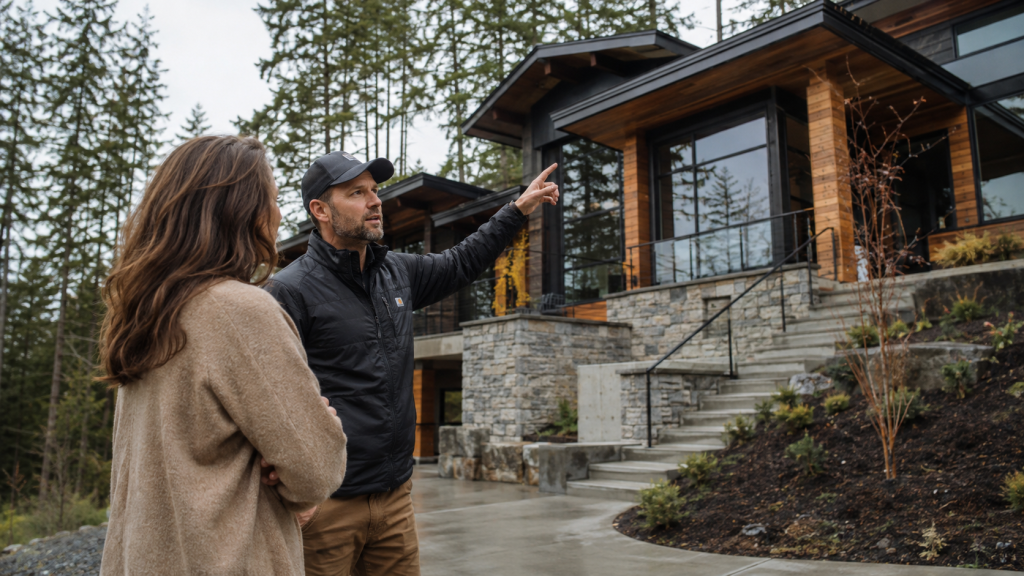
Quick Custom Home Builder Checklist
- Experience – Check for projects with a similar size, budget, and finish level.
- Pricing – Confirm a clear scope, realistic allowances, and defined exclusions.
- Communication – Identify your main contact and establish a consistent update process.
- Local knowledge – Verify their understanding of local codes, permitting timelines, and site conditions.
- Process – Review the preconstruction planning, project schedule, and change-order procedures.
- Reputation – Check verifiable references, independent reviews, and warranty terms.
- Contract – Secure full, written terms in place before any work begins.
Final Takeaway
Choosing a custom home builder isn’t really about finding the lowest number on a bid sheet. It’s about choosing the team that will protect your budget, your timeline, your site, and the quality of the finished home. When figuring out how to choose a custom home builder, look for relevant experience, transparent pricing, real local knowledge, consistent communication, and a documented process that keeps the project organized from the first planning meeting through final walkthrough.
Take the time upfront. It’s far cheaper than fixing the wrong decision six months into construction.
Frequently Asked Questions
Should I choose the cheapest home builder?
Not automatically. A low bid can hide unrealistic allowances, missing scope items, or excluded site work that surfaces later as expensive change orders. Compare full scope and process before comparing price.
How many builders should I compare?
Most homeowners get useful comparison data from three to five detailed bids. Fewer than three limits your ability to spot outliers; significantly more can slow decision-making without adding much new insight.
When should I contact a custom home builder?
As early as possible. Ideally before you’ve finalized land purchase or architectural plans. Experienced builders can flag site or budget issues during the planning phase, when changes are far cheaper to make.