

Walk onto almost any North American job site, and you will see rows of lumber rising from a foundation. Discovering what is light frame construction reveals the hidden engineering that shapes these structures. While it looks like a simple grid of 2x4s, this building method relies on complex physics to keep homes standing.
This guide breaks down exactly how the system works. Dive into the mechanics of wall framing, floor systems, load paths, and connection hardware below to see what truly holds a house together.
What Is Light Frame Construction?
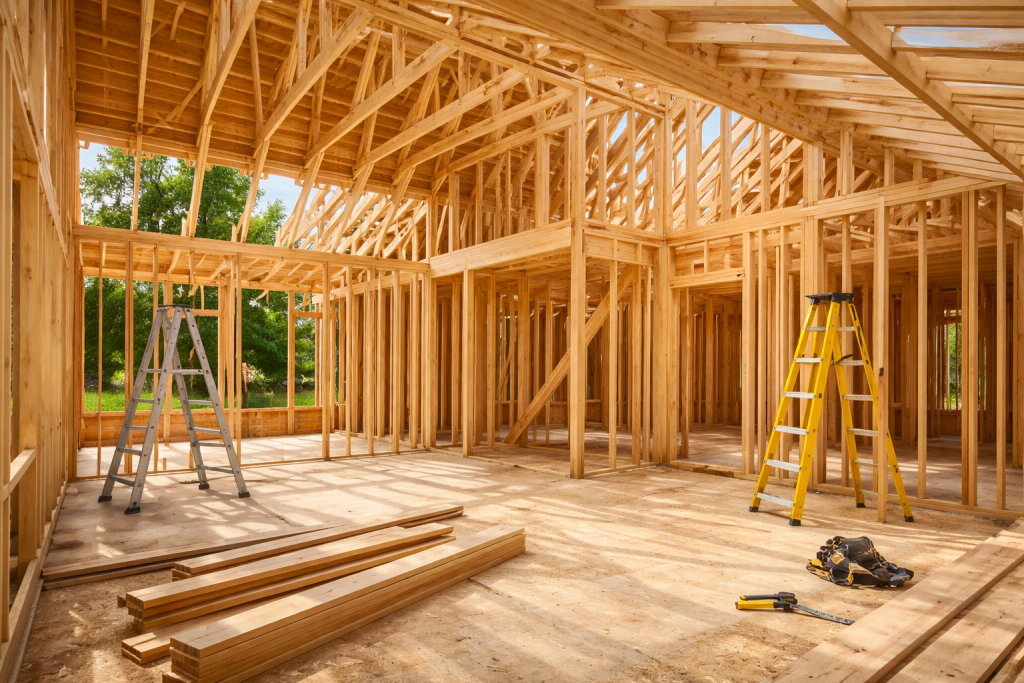
Light frame construction is a building system that uses regularly spaced, relatively small structural members, typically dimensional lumber like 2×4s and 2×6s, fastened together with nails to form the walls, floors, and roof of a structure.
The word “light” refers to the size of the framing members, not the structural capability of the system, and it is one of several different wood framing systems used in residential construction. A properly framed light-frame structure carries enormous loads, resists wind and seismic forces, and routinely outlasts the people who built it.
In North America, light-frame wood construction, classified as Type V construction under the International Building Code (IBC), is used in approximately 90% of new residential construction in the United States.
What is considered light frame construction?
Light-frame construction comprises a specific, well-defined set of materials and assemblies. Understanding what qualifies helps builders, inspectors, and designers communicate precisely and avoid costly misclassifications during permitting and inspection.
Dimensional lumber
The foundation of the system – standard sawn timber in sizes like 2×4, 2×6, 2×8, and 2×10, used for studs, plates, joists, rafters, and blocking.
Engineered wood products
Engineered wood products are now central to modern light-frame systems. For instance, I-joists frame floors and roofs, while Laminated Veneer Lumber (LVL) creates strong headers and beams. Similarly, Oriented Strand Board (OSB) and plywood provide durable sheathing and subfloors. To span larger structural openings, builders rely on glulam timbers and finish the floor perimeters with dedicated rim boards.
This versatile method is suitable for many building types, starting with standard single-family residential homes. Within specific code height limits, it also supports low-rise and mid-rise multifamily buildings. Beyond housing, light-frame systems work well for small commercial properties and mixed-use structures. The same technique also simplifies smaller projects, such as additions, accessory dwelling units (ADUs), and remodels.
What Is Not Light Frame Construction
Light frame construction is frequently confused with other systems. These distinctions matter for code compliance, structural design, insurance, and inspections.
- Post-frame (pole buildings) – Uses large, widely spaced posts embedded in the ground to carry loads. Light frame uses small, closely spaced members.
- Heavy timber – Utilizes large wood members (6×6 or larger) with moment-resisting connections. It carries distinct IBC Type IV fire and structural codes.
- Light gauge steel framing (LSF) – Employs cold-formed steel sections. It mirrors wood layouts but requires thermal breaks, resists termites, and never shrinks.
- ICF and concrete systems – Uses high-mass materials like concrete forms or masonry blocks. They offer superior strength but lack flexibility in architectural modifications.
Light Wood Frame Construction Details
Wall framing systems
A standard light-frame wall consists of vertical studs, typically 2×4 or 2×6 members, spaced 16 or 24 inches on center, attached to a bottom plate and a double top plate, as commonly installed by wood framing contractors. Headers span openings like doors and windows, with sizing determined by load, span, and whether the wall is load-bearing.
Shear walls are the system’s defense against lateral wind and seismic forces. Structural sheathing fastened with a specific nailing schedule, along with hold-down hardware and foundation anchor bolts, transfers lateral forces to the foundation, preventing racking and overturning.
Floor systems
Floor systems begin with a foundation like a slab, crawl space, or basement, and a rim board at the perimeter. Joists span between bearing walls or beams, supporting the subfloor above.
Traditional solid lumber joists have largely been replaced by engineered I-joists, which are lighter, stronger, and dimensionally stable, making them ideal for open floor plans with fewer interior bearing walls.
The subfloor, typically 3/4″ tongue-and-groove OSB or plywood, glued and nailed to the joists, functions as a structural diaphragm, collecting and transferring lateral loads to the shear walls below.
Roof framing
Roof framing is either stick-framed with individual rafters cut and assembled on-site, or built with prefabricated trusses.
Trusses dominate modern residential construction. Engineered to precise load specifications and delivered ready to install, a truss crew can set an entire roof in a single day. They also create cavity space between chords for insulation, ventilation, and mechanical systems.
Stick framing remains common for complex geometries or constrained delivery access. Either way, the roof transfers gravity, wind, and uplift loads to the wall plates below, continuing the load path toward the foundation.
Platform Framing vs. Balloon Framing
Modern light-frame construction uses one of two wall-framing approaches. Knowing the difference matters for both new builds and renovation work.
Platform framing
Built level by level, each floor is constructed on top of the story below to create a stable working surface. Built-in structural blocking naturally limits fire spread between floors. This standard method simplifies connections and remains deeply familiar to modern trades.
Balloon framing
Built with continuous studs, the framing runs from the foundation sill straight to the roof across multiple stories. Common in 19th and early 20th-century builds, it is rarely specified today. These continuous wall cavities act as vertical chimneys during fires, requiring strict fire-blocking updates in historic remodels.
Why Light Frame Construction Dominates Residential Building
The reasons are practical, not sentimental. Light-frame has earned its position as the default residential building system through decades of real-world performance, not marketing.
Availability
Dimensional lumber and engineered wood products are stocked at virtually every building supply outlet in North America. Supply chains are mature, regional, and resilient in ways that imported or specialty materials are not.
Trade knowledge
Carpenters, framers, plumbers, electricians, inspectors, and building officials all know light-frame systems deeply. That shared knowledge base reduces errors, accelerates inspections, and keeps projects on schedule and on budget.
Flexibility
Light-frame construction adapts readily to complex geometries, large window openings, vaulted ceilings, and highly customized layouts. Mid-project design changes, which are inevitable in custom residential construction, are far simpler to accommodate than in concrete or masonry systems.
Speed
An experienced framing crew can complete the structural shell of a single-family home in days, which is a major reason framing speed matters in the overall construction schedule. That speed directly reduces construction financing costs, which matter at every price point.
Code familiarity
The IBC, International Residential Code (IRC), and regional codes have detailed, extensively tested provisions for light-frame construction. Compliance pathways are well-established, reducing permitting friction and inspection uncertainty.
Common Misconceptions About Light Frame Construction
“Light-frame means weaker”
Engineered grids distribute loads evenly. Individual lightweight members form a highly redundant, unified system. When properly sheathed, this flexible grid absorbs seismic energy and resists high winds far better than heavy, rigid masonry.
“It’s only for small homes”
Advanced components scale to mid-rise structures. Modern building codes routinely permit light-frame construction for multi-story commercial and multi-family complexes. Using engineered timbers allows these structures to scale up safely.
“It’s cheaper because it’s lower quality”
Efficiency drives down cost, not poor materials. Standardized, mass-manufactured components assemble rapidly on site. This speed slashes labor costs and reduces material waste while maintaining high structural and thermal performance.
“Anyone can frame it”
Precision matters far more than material weight. While the assembly logic seems simple, improper stud spacing, cut headers, or missing hangers break the structural load path. Unskilled installation leads to structural sagging and inspection failures.
When Light Frame Construction Is the Right Choice
Use cases
- Custom and production housing – Optimal choice when design flexibility and rapid framing speed are prioritized.
- Additions and remodels – Ideal for seamlessly tying new structural sections into existing traditional framing.
- Decks and exterior elements – Preferred standard for projects designed around standard dimensional lumber.
- Multi-unit residential – Best for multifamily complexes fitting within code-allowable height boundaries.
- ADUs and small commercial – Perfect choice when tight budget predictability and schedule certainty are mandatory
Avoidance cases
- High fire-risk zones – Not recommended for structures requiring exceptional, heavy fire-resistance ratings.
- Ultra-wide open layouts – Poor fit for architectural applications requiring exceptionally long clear structural spans.
- Severe environments – Inefficient for locations facing extreme moisture or highly corrosive chemical exposure.
- Passive energy projects – Suboptimal choice when high thermal mass storage is the primary heating or cooling strategy.
How Framing Quality Determines Long-Term Performance
The framing system is the skeleton of a building. Everything downstream, including insulation performance, moisture management, finish quality, door and window operation, and flooring stability, depends directly on the accuracy and integrity of the framing.
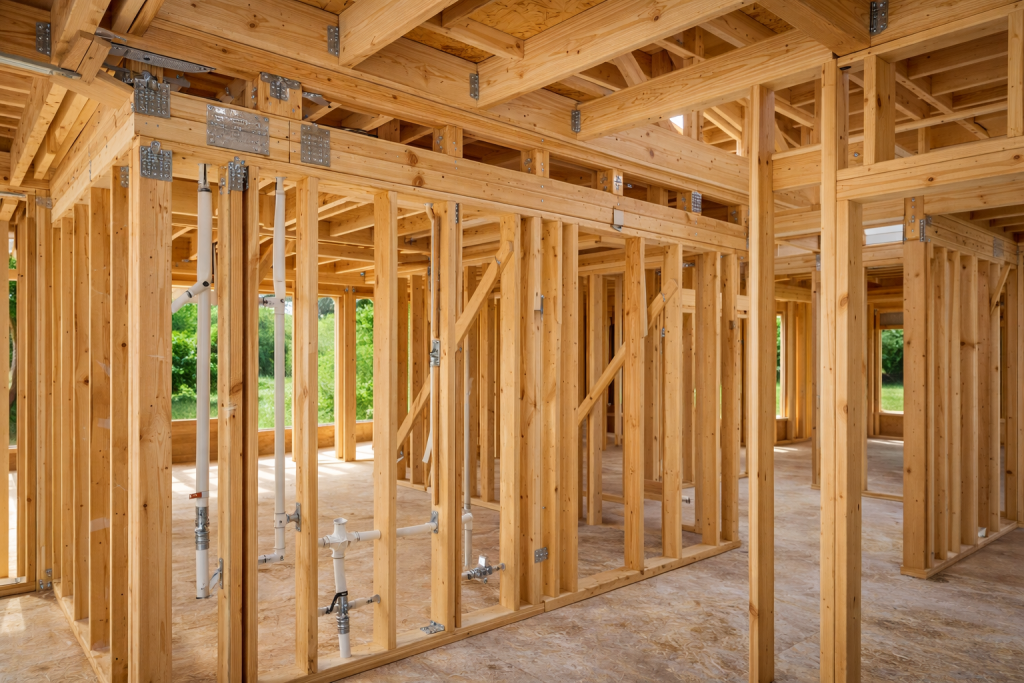
Connections are the critical variable. Wood framing members themselves rarely fail under design loads. The connections between them, like nails, joist hangers, hurricane ties, hold-downs, anchor bolts, are where light-frame structures are most vulnerable to lateral and uplift forces. Specifying, installing, and preparing for framing inspection of connections to code is not optional. It is the single most important determinant of how a light-frame building performs when it matters most.
Conclusion
Light frame construction is more than just a building method; it’s the backbone of residential construction across North America. Understanding what is light frame construction, how it works, and where it performs best gives builders, homeowners, and inspectors a clearer picture of what goes into every well-built home.
At the end of the day, the system is only as good as the people who execute it. With the right approach to connections, load paths, and framing precision, light frame construction delivers results that are fast, flexible, and built to last.