

Walk through any pre-1940 neighborhood, and you’re looking at history held together by long, continuous studs running from foundation to roofline. That’s balloon framing, once dominant across America, now largely a relic. Today, almost every new home relies on platform framing instead, and the reasons why tell an interesting story.
Understanding platform framing vs balloon framing matters, especially when renovating an older home. In this article, you’ll learn how each system works, where they differ structurally, and what those differences mean in practice.
Platform Framing vs Balloon Framing
The fundamental difference between balloon framing and platform framing lies in where the studs stop.
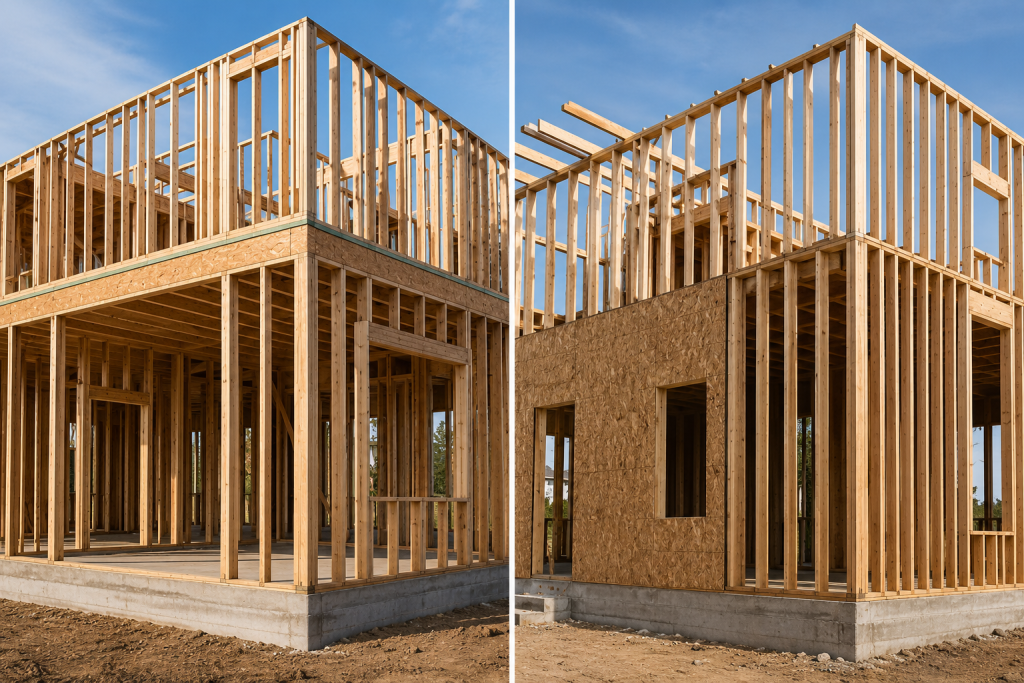
In platform framing, walls are discontinuous. Studs run only from the subfloor to the ceiling in a single-story building, making each floor an independent unit. Structural loads are transferred through the floor assembly at each level before being carried down to the foundation.
In contrast, balloon framing relies on continuous walls. Studs run uninterrupted from the foundation sill to the roof plate, bypassing the floors entirely. Instead of resting on top of a wall, upper-floor joists hang from ribbon boards notched into the sides of these full-height studs, leaving no horizontal structural break from basement to roof.
This single distinction between floor-by-floor framing and continuous studs drives every downstream consequence, directly impacting fire safety, insulation efficiency, code compliance, and renovation complexity.
What is Platform Framing?
Platform framing is the standard wood-frame construction method used in virtually every new residential build in the United States and Canada. Each floor level is framed as a self-contained unit. The crew frames the floor system, sheathes it to create a flat working surface, and then erects the wall framing for that story on top of it. The process repeats story by story.
This method became dominant through the 1940s and 1950s as standardized dimensional lumber production made it practical at scale. By the 1960s, it had permanently replaced balloon framing as the default approach, and it has remained the standard ever since. Modern building codes in every U.S. state and Canadian province treat it as the expected baseline for wood-frame residential construction.
Structural advantages of platform framing
- Built-in fire blocking – Subfloor assemblies naturally seal vertical wall cavities, preventing fire and smoke from traveling between floors.
- Safer construction – Workers build on a flat, solid deck at every story, reducing the reliance on scaffolding and lowering site safety risks.
- Predictable load paths – Structural weight transfers consistently at each floor level, simplifying engineering calculations and building inspections.
- Modern system integration – Clear floor breaks make it easier to install standard insulation, airtight vapor barriers, and mechanical rough-ins.
- Standard material savings – The design relies entirely on readily available dimensional lumber (like 2x4s and 2x6s), reducing material costs.
Structural limitations of platform framing
- Cumulative vertical shrinkage – Horizontal wood members shrink as they dry over time, causing minor but measurable settling that accumulates at each floor assembly in multi-story buildings.
- Exterior cladding alignment – In taller structures, this cumulative shrinkage requires careful detailing to prevent exterior gaps, siding buckling, and misalignment at wall penetrations.
- Tall-wall engineering needs – Double-height spaces or uninterrupted walls require specialized engineering, extra hold-downs, or engineered lumber, especially in high-wind or seismic zones.
What Is Balloon Framing?
Balloon framing is an early wood-frame construction method that uses long, continuous wall studs running from the foundation to the roofline. It emerged in the 1830s as a faster, cheaper alternative to traditional timber framing. The availability of mass-produced lumber and machine-cut nails allowed builders to construct homes without the specialized skills required for mortise-and-tenon joinery, helping fuel rapid urban growth across North America.
From the mid-19th century through the 1930s, balloon framing became the dominant residential construction method, shaping much of the Victorian and Edwardian housing stock that still exists today. As concerns grew over the fire risks created by continuous wall cavities, the industry gradually shifted to platform framing during the postwar building boom. Today, balloon framing is largely a historical construction method found only in older homes.
Structural advantages of balloon framing
- Continuous vertical load paths – Full-height studs transfer roof and wall loads directly to the foundation, without horizontal floor interruptions, keeping century-old homes highly stable.
- Reduced tall-wall shrinkage – Because studs span the entire building height without splices, exterior cladding and interior finishes experience minimal vertical movement and settling over time.
- Simplified tall openings – Uninterrupted stud heights allow for tall window and door openings without the complexity of stacking cripple walls, preserving original proportions in historic structures.
Major risks and limitations of balloon framing
- Rapid vertical fire spread – Unobstructed wall cavities run continuously from the basement to the roof, acting as flues that rapidly channel flames and smoke to every floor during a fire.
- Mandatory retrofit fire blocking – Modern building codes strictly require horizontal fire blocking to be installed at each floor level during any renovation that exposes original wall cavities.
- Challenging insulation upgrades – Adding standard insulation batts requires completely stripping interior walls, while blown-in insulation through drilled access holes is difficult to distribute around existing floor ledger boards.
- Scarce and expensive long lumber – Sourcing the 18- to 20-foot studs required for full-height walls is highly expensive and logistically difficult because old-growth trees are no longer used for standard lumber.
- Complex structural modifications – Altering load-bearing walls differs significantly from modern conventions, requiring a structural engineer’s assessment to avoid creating unsafe loading conditions.
Platform vs Balloon Framing: Side-By-Side Comparison
| Characteristic | Platform Framing | Balloon Framing |
| Stud Length | Short (floor-to-ceiling per story) | Long (foundation to roof, up to 20+ ft) |
| Load Path | Transferred through each floor platform | Continuous vertical through full-height studs |
| Fire Safety | Built-in fire blocking at every floor | Open wall cavities act as vertical flues |
| Code Compliance | Meets modern codes as-is | Requires retrofit fire blocking |
| Lumber Availability | Standard dimensional (easy to source) | Long studs increasingly scarce and costly |
| Labor Efficiency | High – crews work on flat platforms | Lower – requires scaffolding and staging |
| Vertical Shrinkage | Minor cumulative settling at each floor | Less shrinkage on tall continuous walls |
| Tall Wall Performance | Requires engineered solutions | Naturally strong for uninterrupted height |
| Modern Residential Use | Standard – virtually all new builds | Rare – historic and specialty use only |
| Renovation Complexity | Straightforward | Higher cost; engineering sign-off often required |
Fire Safety, Fire Blocking, and Building Code Reality
Fire safety is not a secondary consideration in framing; it is the primary reason one system replaced the other. The open wall cavities in balloon framing were responsible for catastrophic fire spread in pre-war urban housing. Cities like Chicago, which were densely built with balloon-framed structures, experienced devastating fires that moved rapidly through entire blocks because wall cavities connected every floor and the attic in one continuous vertical channel.
Modern building codes address this directly. The International Residential Code (IRC) and its state and provincial equivalents require fire blocking at specific intervals in wood-frame construction: at ceiling and floor levels, at the top and bottom of stairs, and at any point where a concealed space connects different areas of the structure. Platform framing satisfies these requirements automatically. Balloon framing does not.
When a permit is pulled for renovation work on a pre-1940 home, inspectors routinely condition approval on the installation of fire blocking in all wall cavities. This is not a cost-saving opportunity; it is a code requirement. Budget for it.
Why Platform Framing Dominates Modern Construction
The shift from balloon to platform framing was a decisive post-war transition. By the late 1950s, platform framing became the near-universal standard for modern wood-frame residential construction across North America, a dominant position it has held for nearly 70 years.
Several industry forces drove this rapid adoption. Post-World War II housing demands required fast, safe construction, which platform framing delivered via stable, floor-by-floor working surfaces. Stricter post-war fire codes favored the method because it naturally blocks vertical flames without extra retrofits. Concurrently, supply chains standardized around shorter lumber, making long balloon-frame studs scarce and expensive.
Today, modern energy codes reinforce this dominance. Strict energy laws demand advanced air sealing, continuous insulation, and precise thermal assemblies. Platform framing seamlessly integrates with these systems, whereas the continuous cavities of older balloon framing create ongoing challenges for maintaining modern insulation and air barriers.
When Balloon Framing Still Makes Sense
In new construction – almost never. The code-compliance burden, lumber sourcing challenges, fire safety requirements, and insulation difficulties make balloon framing impractical for any standard residential project.
There are narrow exceptions. Historic preservation projects, particularly church renovations, Victorian-era residential restorations, or heritage commercial buildings, may warrant retaining or replicating balloon-framed assemblies to preserve original proportions and character. Certain architectural programs that require uninterrupted two-story wall heights may explore balloon-framing principles, typically with engineered lumber and full structural engineer oversight.
If you are working in one of these situations, engage a licensed structural engineer from the start. These are specialty applications that require engineering judgment, not standard practice.
Framing Method Selection
Framing errors compound exponentially across later trades, disrupting the framing timeline, drywall, MEP rough-ins, cladding, and window installations. Correcting a framing defect after drywall installation costs up to 10 times as much as fixing it immediately.
For new North American residential construction, platform framing is the standard default. It utilizes standard material supply chains, relies on universally understood labor methods, and simplifies insulation and HVAC integration. This system ensures predictable, code-compliant results without engineering delays.
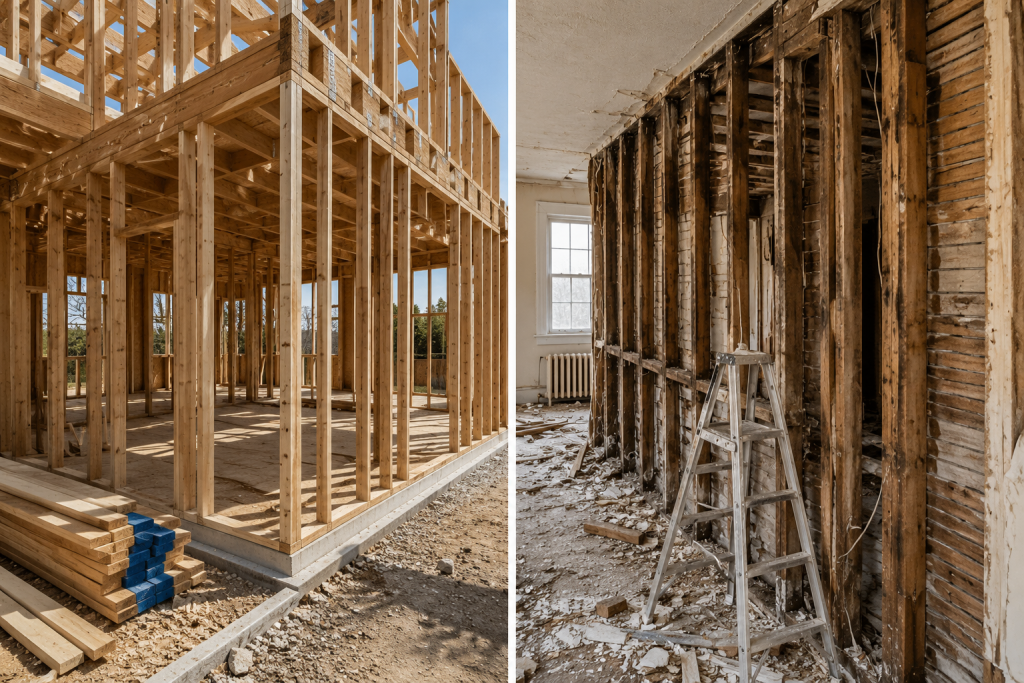
For pre-1940 renovations, builders must diagnose the existing structural system via exploratory demolition before pricing the project. Early identification of legacy systems, like balloon framing, allows contractors to factor in mandatory code upgrades, such as retrofitting fire-blocking, before contract signing.
Conclusion
The choice between platform framing vs balloon framing isn’t really a debate for most modern projects. Platform framing wins on safety, code compliance, and practicality, and has for decades. Balloon framing belongs to a specific era, and understanding it matters most when that era is part of your renovation scope.
Whether you’re building new or working through a pre-war gut job, knowing how these systems behave changes how you plan, price, and execute the work. The framing is where everything begins. Get that part right, and the rest of the build has a solid foundation to stand on.