

Understanding construction costs is essential for creating a realistic home-building budget. From the earliest planning stages through construction and completion, a project can involve a wide range of expenses that need to be accounted for. Knowing what to expect at each stage can make it easier to plan your spending and avoid costly surprises later.
This guide explores hard costs vs soft costs, what each category typically includes, when these expenses occur, and how they fit into an overall construction budget. It also covers costs that may fall outside these categories, such as land, furnishings, and contingency funds, to help you create a more complete picture of your total project costs.
Hard Costs vs Soft Costs at a Glance
| Factor | Hard Costs | Soft Costs |
| Purpose | Physically construct the home | Make construction possible |
| Examples | Labor, materials, equipment | Design, permits, financing |
| Timing | Primarily during construction | Before, during, and sometimes after construction |
| Main Budget Risk | Material, labor, site, and scope changes | Missing fees, delays, professional services, and financing costs |
| Ease of Estimating | Usually more measurable | Often less predictable |
| Connection to the Building | Direct | Indirect |
Hard costs generally make up the largest share of a construction budget because they include the labor and materials required to build the structure itself. Soft costs usually make up a smaller share, but the exact relationship varies significantly with project type, complexity, financing, jurisdiction, and scope.
What Are Hard Costs in Construction?
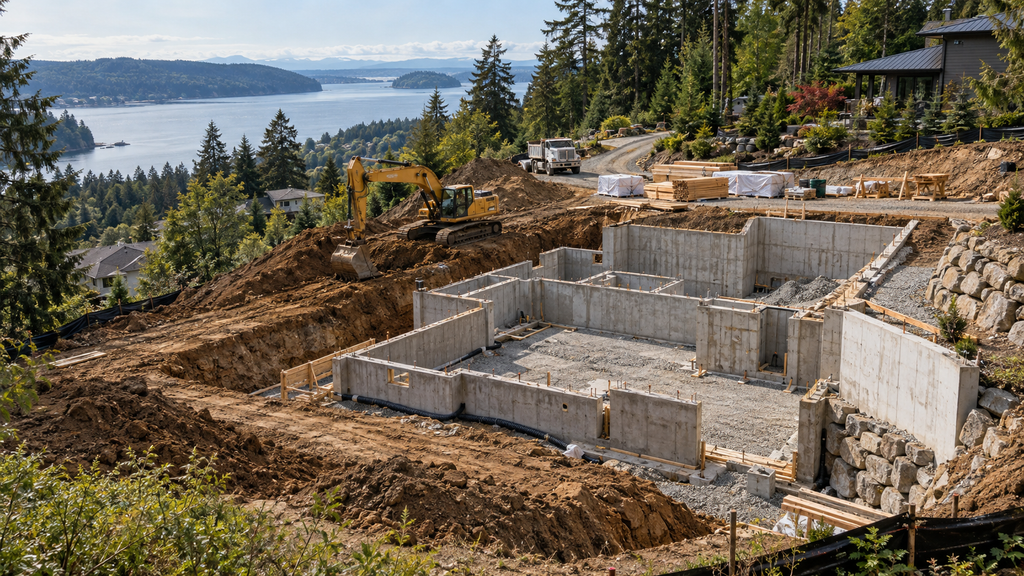
Hard costs in construction are the labor, materials, equipment, and physical work needed to build a home.
Typical hard costs include:
- Sitework – Excavation, grading, foundations, driveways, paving, utilities, and other site preparation
- Structure – Framing, roofing, cladding, windows, and doors
- Systems – Plumbing, electrical, HVAC, and insulation
- Interior finishes – Drywall, flooring, cabinets, countertops, paint, and permanent fixtures
- Labor and equipment – Construction labor, trades, subcontractors, and equipment
- Exterior work – Contracted landscaping and other permanent improvements included in the construction contract
Industry sources generally classify labor, materials, equipment, structural work, building systems, and permanent finishes as hard costs.
What makes hard costs change?
Hard costs are tangible, but they are not fixed. The final amount depends on the home’s square footage, complexity, structural system, materials, labor market, lot conditions, location, and schedule.
A steep site may require more excavation or retaining work, while complex rooflines, large glass openings, premium finishes, custom cabinetry, and elaborate outdoor spaces can increase costs.
Framing can also represent a significant construction expense, which is why understanding how much it costs to frame a house can help clarify one major portion of the structural budget.
Market conditions also matter. Material prices, labor availability, scope changes, weather delays, and regulatory requirements can affect costs during construction. An early construction estimate should therefore never be treated as the final price.
What Are Soft Costs in Construction?
Soft costs are expenses for planning, designing, financing, approving, coordinating, and managing a construction project. Unlike hard costs, they are not directly tied to the physical work or materials used to build the structure.
For a custom home, soft costs may include architect and engineering fees, design services, surveys, geotechnical and environmental studies, permits, inspections, utility connection fees, legal and accounting services, appraisals, loan interest and financing fees, insurance, project administration, and consultants.
Many of these expenses begin during preconstruction, before physical building work starts.
These costs can begin months before construction and continue throughout the project. Design revisions, site visits, permitting issues, and inspection requirements can create additional expenses.
Why soft costs are harder to predict
Hard costs are often easier to estimate because they are tied to measurable quantities, such as concrete, roofing, and labor. Soft costs can be more difficult to predict because they are often affected by project timelines, approvals, design changes, and professional requirements.
Permitting delays, expanded engineering requirements, design revisions, and longer construction schedules can increase consulting, financing, and administrative costs. Some soft costs may even continue after construction is complete, making them easier to overlook and harder to forecast.
Costs That Do Not Always Fit Neatly
The biggest mistake in a hard vs soft costs construction comparison is assuming every expense fits neatly into one universally accepted category. It does not.
Land acquisition
Land is often tracked separately from the construction budget. Some financial models place it among soft or development costs, while others maintain an independent land-acquisition category. For homeowners, the label matters less than whether the expense appears in the total project budget.
Furniture and owner-purchased items
Freestanding furniture, electronics, window treatments, décor, and appliances purchased directly by the homeowner may sit outside the builder’s contract. Permanent built-ins and fixtures, however, are more commonly included as hard costs when they form part of the completed construction.
Contractor overhead and profit
General contractor overhead and profit are another gray area. They may be embedded within individual construction prices, shown as separate line items, or included within the overall contract value. The homeowner should therefore understand how the builder’s estimate is structured rather than assuming every company categorizes these costs identically.
Permits
Permits are usually treated as soft costs in residential-development budgets because they are regulatory rather than physical construction expenses. However, estimating systems and contracts sometimes allocate them differently.
Procore’s own guidance illustrates why terminology alone can mislead: its high-level overview includes permits among hard costs, while its detailed soft-cost discussion lists permitting costs as soft expenses. For budgeting purposes, consistent treatment matters more than the label.
Contingency
Contingency is not automatically a hard cost or a soft cost. A builder may carry construction contingency for unforeseen physical work. An owner may maintain a separate reserve for design changes, permitting delays, financing extensions, or other project risks.
Keeping contingency visible as its own budget line often provides more clarity than burying it inside another category.
When Hard and Soft Costs Occur
The difference between soft costs vs hard costs construction becomes clearer when you look at when each expense occurs during the project.
Soft costs typically begin first, during planning and preconstruction. These may include feasibility studies, surveys, architecture, engineering, soil testing, financing, appraisals, permits, and other professional services.
Hard costs rise once physical construction begins. Excavation, foundations, framing, roofing, mechanical systems, finishes, equipment, and subcontractor labor make up most of these expenses.
Soft costs can continue throughout construction and beyond, including financing, insurance, inspections, professional services, and administration. This means the two cost categories often overlap rather than occurring in completely separate phases.
Why Homeowners Underestimate Soft Costs
Homeowners often focus on the construction contract because it appears to represent the cost of the house. That can create a major budgeting blind spot.
Even when a builder estimates construction accurately, several owner-paid expenses may fall outside the contract. Architectural work, surveys, engineering, permits, financing, utility connections, legal services, site studies, and owner selections can all increase the final investment.
Because these costs are spread across different stages of the project, they are easy to overlook. A realistic budget should account for both the cost of building the home and the professional, regulatory, and financial expenses required to complete it.
For regional context, reviewing the average cost to build a house in Washington State can help show how construction costs fit into the broader project budget.
Price per square foot is not an all-in budget
Price-per-square-foot estimates are useful for comparing construction options, but they rarely represent the full cost of developing a home. For example, a $300-per-square-foot construction estimate may not include land, architectural and engineering fees, loan interest, permits, landscaping, utility connections, specialty consultants, furnishings, or contingency costs.
These expenses can add substantially to the total project budget, even when the construction estimate itself is accurate. That is why two homes with the same square footage can have very different final costs. Price per square foot should therefore be treated as a construction benchmark, not an all-in project budget.
Design changes affect both categories
Changing a project after the design has progressed can increase both soft and hard costs. Architects or engineers may need to revise drawings, update specifications, or resubmit plans for review. That raises soft costs. At the same time, contractors may need different materials, additional labor, new orders, or revised schedules, which increases hard costs.
Once construction is underway, these adjustments may also require a formal change order to document changes to cost, scope, or schedule.
Late changes are especially expensive because they can affect work that has already been priced, ordered, scheduled, or installed. The earlier a change is made, the easier it is to control its cost. Once construction is underway, even a small design decision can create expenses across several parts of the project.
Time is a budget variable
Schedule delays do more than push back the move-in date. They can also increase the total cost of the project. A longer construction period may mean more loan interest, insurance expenses, professional-service fees, temporary housing costs, and other carrying expenses.
Some delays can also affect contractor schedules, material deliveries, inspections, or consultant work, creating additional costs beyond the original budget. That is why schedule management is also cost management. Keeping decisions, approvals, and construction moving on time can help control both soft costs and the overall project budget.
Understanding how long it takes to build a custom home can therefore help homeowners plan for costs that depend on the project timeline.
How to Budget for Hard and Soft Costs
The strongest construction budget is not simply a builder estimate with a contingency percentage added at the bottom. It is an all-in financial map of the entire project.
Start with the total project cost
Separate the budget into clearly defined categories such as land, hard construction costs, soft costs, owner purchases, and contingency. This prevents a construction contract from being mistaken for the full investment required to complete the home.
Ask what the builder’s price excludes
What a builder leaves out of the estimate can matter just as much as what is included.
Ask specifically whether the proposal covers sitework, utility connections, landscaping, permit fees, appliances, engineering, testing, driveway work, specialty finishes, and other major project expenses. These exclusions can significantly change the final cost of the home. A lower estimate is not necessarily the better deal if thousands of dollars in required work must be paid separately.
Understanding the exclusions upfront makes it easier to compare builders accurately and build a realistic total project budget. This is also an important part of choosing a custom home builder.
Separate allowances from fixed pricing
An allowance is not the same as a final price. It is a placeholder amount set aside for items that have not yet been fully selected or priced. If the budget includes allowances for flooring, plumbing fixtures, cabinetry, countertops, lighting, or appliances, compare those amounts with the quality level you actually plan to purchase.
Allowances that are set too low can make the initial estimate look more affordable than the project will really be. Once selections are made, the difference becomes an added cost. Review each allowance carefully and make sure it reflects realistic choices before treating the budget as complete.
Track hard costs and soft costs independently
Tracking hard costs and soft costs separately makes it easier to see where the budget is changing. For example, material upgrades may increase hard costs while extended approvals, design revisions, or additional consulting increase soft costs. Combining everything into one number can hide what is actually driving the overrun.
Detailed cost codes and regular forecasting make this easier, especially on complex projects. Procore emphasizes defining scope, developing detailed cost estimates, tracking budgets and changes, and monitoring subcontractor costs to improve control over construction expenses. Separate tracking gives homeowners and project teams a clearer view of where money is being spent and where corrective action may be needed.
Update the budget as the design becomes more certain
Early estimates rely on assumptions, but those assumptions should be replaced with real costs as the project develops. Reprice the project as the architectural design progresses, structural engineering is completed, site conditions become clearer, and major materials and finishes are selected.
Each new decision reduces uncertainty and improves pricing accuracy. Regular budget updates also make it easier to identify potential overruns before they become expensive problems. As the design becomes more complete, the budget should become more precise and better reflect the true cost of the project.
Involve the builder early
Waiting until construction documents are complete to discover that the design exceeds the budget wastes time. Early builder involvement can identify expensive structural choices, difficult site conditions, labor-intensive details, material risks, or constructability issues while changes are still relatively inexpensive.
Value engineering works best before construction begins, not after the budget has already failed.
The Most Important Budget Number Is the Number Nobody Included
Most homeowners focus on expensive finishes, but a bigger risk is overlooking costs that were never included in the original estimate. For example, a missing $20,000 requirement can create more financial strain than a clearly identified $20,000 upgrade. The upgrade is a planned choice, while the unexpected requirement can disrupt the entire project budget.
This highlights the key lesson behind hard costs vs soft costs. Good budgeting is not about placing every expense into a perfect category. It is about identifying the project’s full financial scope as early as possible. With a complete budget from the start, homeowners can reduce the risk of costly surprises later.
Final Takeaway
Hard costs and soft costs are both essential to building a custom home. Understanding hard costs vs soft costs means looking beyond the physical construction itself to account for the costs of designing, approving, financing, coordinating, and completing the project. A reliable budget should account for both while clearly separating land, allowances, owner purchases, exclusions, and contingency.
Before comparing builder estimates, check what each one actually includes. The lowest construction price can become the most expensive project when significant costs fall outside the proposal. A clear cost structure from the start can help prevent costly surprises later.
If you are planning a custom build, working with experienced home builders in Washington State can also help you understand how those costs come together across the full project.