
Choosing between post frame vs stick frame construction isn’t just a budget decision; it’s a structural one. Both wood framing systems build strong, code-compliant buildings. Both have been doing it for decades. But they solve fundamentally different problems, and picking the wrong one can cost you time, money, and flexibility for years to come.
This guide cuts through the marketing noise. No cheerleading for one method over the other – just a clear, honest breakdown of how each system works, where each one excels, and how to match your choice to your actual goals.
Post Frame vs Stick Frame Construction
Choosing between these methods requires balancing structural flexibility with traditional design standards.
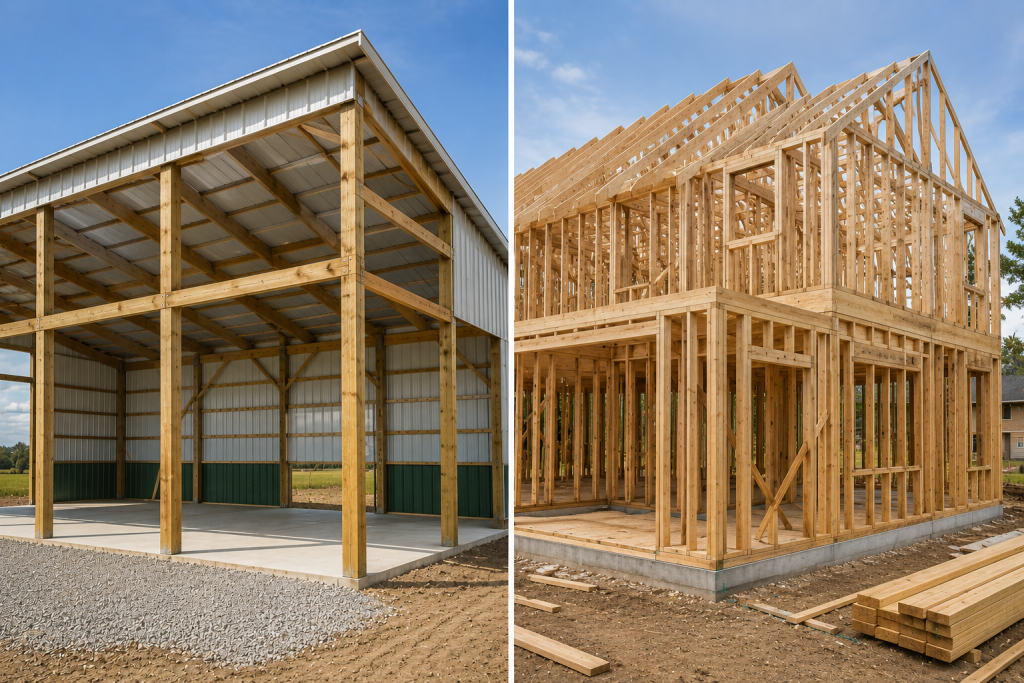
Post-frame buildings utilize heavy timber columns spaced six to 10 feet apart to transfer vertical and lateral loads directly into the ground, eliminating the need for a continuous perimeter foundation. Because the walls between these posts are non-structural, this system uses fewer materials and can clear-span up to 80 feet without interior columns. This makes future remodeling simple, though it requires precise upfront engineering for wind and seismic resistance.
In contrast, light-frame construction distributes weight across closely spaced studs, joists, and rafters stacked vertically onto a solid concrete foundation. While this creates a highly adaptable layout for traditional rooms, it requires more components and relies on interior load-bearing walls that restrict open-concept spaces. It remains the residential standard because it is universally understood by contractors and local building codes.
Foundation Requirements
Foundation work highlights the biggest cost gap between these two systems and has a direct impact on the framing timeline.
Post-frame foundations
- No perimeter footings – Posts embed directly into the ground or onto isolated concrete piers.
- Lower costs – Eliminates extensive excavation, cutting foundation costs by 30% to 40%.
- Faster builds – Installation takes days rather than weeks.
- Optional slabs – Buildings can utilize gravel or compacted dirt floors instead of concrete.
- Soil dependency – Requires careful engineering and treated posts in poor or wet soils to prevent rot.
Stick-frame foundations
- Continuous footings – Demands a full concrete perimeter footing, stem wall, or basement.
- High investment – Labor and materials consume 15% to 25% of the total project budget.
- Mandatory slabs – Requires an integrated concrete slab for finished floors.
- Extensive site work – Involves prolonged excavation, forming, and curing time.
Post Frame vs Stick Frame Cost
Post-frame construction generally offers lower upfront and long-term construction costs than stick-frame construction, particularly for large, open-span buildings.
| Cost Category | Post-Frame Construction | Stick-Frame Construction |
| Shell Cost | $35 to $45 per square foot. | $45 to $60 per square foot. |
| Foundation | Low cost; uses isolated piers or embedded posts. | High cost; requires continuous perimeter footings. |
| Labor Time | Frames 50% faster, reducing crew costs. | Slower assembly increases total on-site labor hours. |
| Insulation | Deep cavities, but requires slab-edge detailing. | Standard installation, but creates thermal bridges. |
| Interior Finish | Requires additional furring strips before drywall. | Instantly ready for utilities and drywall rough-in. |
| Maintenance | Low upkeep due to durable, paint-free steel cladding. | Moderate ongoing costs for siding paint and sealing. |
Financial analysis and use cases
As a benchmark example, a hypothetical 30-year lifecycle model for a 4,000-square-foot workshop estimates post-frame expenses at $271,000 compared to $335,000 for stick-frame. This substantial savings potential makes post-frame the ideal financial choice for equipment storage, agricultural builds, and commercial garages.
On the other hand, traditional stick-frame construction delivers a much better return on investment for primary residences and multi-story homes. Stick-frame also remains the superior option for projects requiring conventional residential lending or maximum urban resale value.
Post Frame vs Stick Frame Home Applications
Both framing systems build excellent houses, but they serve different residential goals. Post-frame homes, or barndominiums, excel as spacious single-story rural builds on slab foundations. They easily deliver vaulted ceilings and wide-open layouts that are difficult to replicate with traditional framing. However, post-frame buyers often face strict resistance from traditional mortgage lenders and lower initial property appraisals.
Alternatively, stick-framing remains the standard choice among traditional residential framing methods for multi-story homes, complex rooflines, and finished basements. This traditional method integrates into any architectural style and fits seamlessly within strict urban neighborhood design standards. Contractors, local inspectors, and resale buyers universally understand stick-frame homes, ensuring a smooth path for conventional financing and long-term resale value.
Insulation & Energy Performance
Both framing systems easily meet modern energy codes, meaning installation quality matters far more than the construction type itself.
Post-frame walls reduce thermal bridging because the wide 6-to-10-foot post spacing creates large, continuous insulation cavities. This design allows you to achieve high R-38 values with standard batts and exterior rigid foam, though builders must carefully detail the thermal break at the floor slab-exterior wall junction.
In contrast, traditional stick-frame insulation follows well-documented, code-compliant sealing strategies that every local contractor understands. The primary downside is that closely spaced studs create frequent thermal bridges, requiring exterior rigid foam or advanced framing strategies to achieve optimal efficiency.
Seismic & Wind Considerations
Both systems can be engineered to withstand severe wind, earthquakes, and heavy snow, but they resist these lateral forces differently.
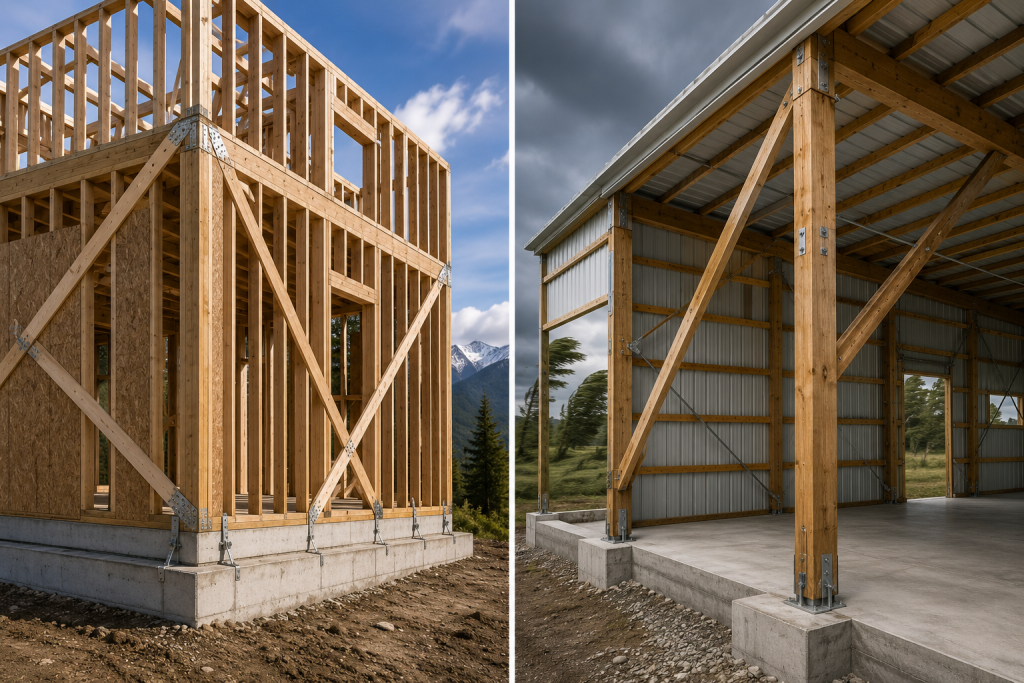
Stick-framing has a long, proven track record in active seismic zones. It utilizes engineered shear walls, such as plywood or OSB panels with specific nailing patterns and heavy-duty hold-down hardware, creating a mature system that local building departments thoroughly understand.
On the other hand, post-frame structures rely on deep post embedment, bracing, and roof diaphragm action to resist lateral loads. While highly effective, this method requires precise upfront engineering from a licensed professional, making structural framing work an area where builders cannot cut corners.
Long-Term Durability
Neither system is inherently fragile; both reward good construction detailing and penalize neglect.
Post-frame buildings routinely last 40 to 60 years, and often exceed a century, when using columns pressure-treated to UC4B standards. The primary vulnerability is ground-level moisture, making proper drainage and wood protection essential to manage decay risks over time.
Stick-frame structures offer excellent durability because the wood framing sits safely above the concrete foundation, isolated from ground moisture. However, these buildings remain vulnerable to internal wall cavity condensation if vapor barriers and exterior flashing are not properly managed in humid or freeze-thaw climates.
Choosing Your Building Method
When post-frame is the smarter choice
- Large workshops, agricultural barns, and oversized vehicle or boat storage
- Budget-sensitive projects and tight timelines prioritizing foundation cost savings
- Single-story barndominiums and multi-use flex buildings on rural land
When stick-frame is the smarter choice
- Primary residences, multi-story homes, and attached neighborhood garages
- Urban infill lots and properties governed by strict HOA design standards
- Projects requiring conventional bank financing and immediate interior utility installation
Conclusion
The choice between post frame vs stick frame construction depends entirely on matching the right system to your specific project goals. Both methods deliver exceptional durability when used correctly, whether you prioritize the open-span cost efficiency of a post-frame build or the traditional design flexibility of a stick-frame home. By honestly evaluating your budget, project timeline, and site conditions, the best choice for your unique project will become clear.