

Navigating Pacific Northwest zoning laws is the ultimate hurdle for minimalist living, with legal rules shifting drastically depending on whether your home sits on wheels or a foundation. From urban backyard lots to rural acreage, securing your ideal spot depends entirely on matching your home’s design with local municipal frameworks.
This guide details the zoning, permitting, and property requirements needed to legally establish your home. Read on to master regional regulations, compare foundation versus wheeled criteria, and discover exactly where can you put a tiny house in Washington State.
Are Tiny Homes Legal in Washington State?
Yes. Washington has one of the nation’s most progressive legal frameworks for tiny homes, driven by these key regulations:
- Senate Bill 5383 (2019) – Defined a tiny house as a dwelling of 400 square feet or less and mandated official state construction standards.
- Appendix Q (2021) – Governs foundation-backed tiny homes, setting specific requirements for ceiling heights (6′4″–6′8″), room sizes (min. 70 square feet), and emergency egress.
- House Bill 1337 (2023) – Expanded ADU rights statewide, allowing two units per lot without requiring owner occupancy.
- L&I FAS Program – The Department of Labor & Industries inspects and approves all off-site and factory-built tiny homes, bypassing local building departments.
Why local regulations still matter
State law sets the floor, but counties and cities control the ceiling. Even though Washington adopted Appendix Q, individual jurisdictions must implement it locally before it applies in their area. Many cities layer on additional restrictions, including setback requirements, strict energy codes, seismic standards, lot coverage limits, and mandatory parking spaces.
As a vital takeaway, you must always verify rules with your local planning department before buying land, purchasing a unit, or breaking ground.
Tiny House on Wheels vs. Tiny House on a Foundation
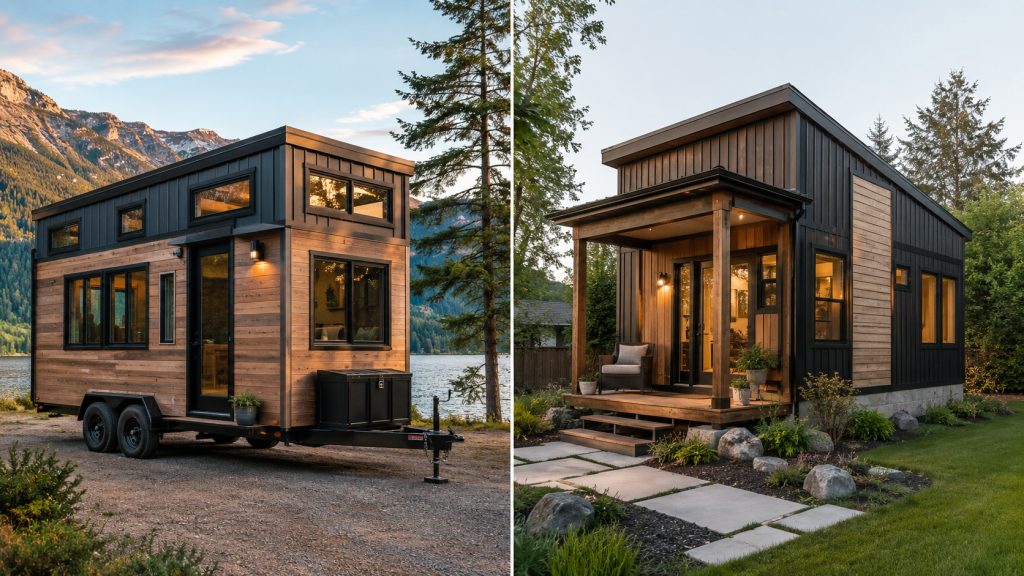
Choosing between a mobile or permanent foundation is the most critical decision under Washington law, as the wrong classification can trigger expensive compliance penalties. This single distinction dictates your entire zoning, permitting, and building code pathway.
Tiny houses on permanent foundations
Foundation-built tiny houses are treated as permanent residential structures. They follow the same permitting pathway as a standard single-family home. They qualify for real property status (which allows conventional mortgage financing) and can be placed in residential zones as primary dwellings or accessory dwelling units.
They must meet the IRC Appendix Q, the Washington State Energy Code, the Uniform Plumbing Code, the National Electrical Code, and local seismic and soil requirements.
Tiny houses on wheels (THOWs)
THOWs are classified as recreational vehicles under Washington State law, specifically as Park Model Recreational Vehicles (PMRVs) when designed for semi-permanent use. L&I’s FAS program regulates its construction.
Here’s the critical nuance that trips people up – removing the wheels and setting a THOW on a foundation doesn’t reclassify it as a permanent dwelling. Many counties still treat it as an RV, restricting full-time residency outside of designated mobile home parks or RV communities, regardless of how house-like it looks.
Under RCW 36.01.225 and RCW 35.21.684, Park Model RVs can serve as legal primary residences if they are placed in a licensed mobile home community, hooked up to utilities, and meet all local standards.
How classification affects placement
| Feature | Foundation Tiny Home | THOW |
| Legal Status | Permanent dwelling | Recreational vehicle |
| Placement Options | Residential zones, ADU, rural lots | RV parks, mobile home communities, some ADU zones |
| Financing | Standard mortgage eligible | RV loan or personal financing |
| Full-time Residency | Yes, with proper permits | Limited outside approved communities |
| L&I Oversight | FAS program (off-site builds) | FAS program + RVIA certification |
Where Can You Legally Put a Tiny House in Washington State?
On private residential property
Foundation-built tiny homes can serve as primary residences on privately owned residential lots, provided the lot meets minimum size requirements (typically 5,000-10,000 square feet in urban areas). The home must also comply with local zoning setbacks, lot coverage rules, and utility connection requirements.
As an accessory dwelling unit (ADU)
Placing a tiny home as an ADU is the top option in Washington’s cities and suburbs. House Bill 1337 (2023) expanded statewide ADU rights by permitting up to two units per urban lot, removing owner-occupancy mandates, allowing separate condo sales, and banning HOA restrictions.
Because local ADU caps of 800-1,200 square feet comfortably exceed the tiny home threshold, structures fit easily into this pathway. Cities like Seattle, Tacoma, Bellevue, Kirkland, Vancouver, and Kent explicitly permit tiny home ADUs, with Seattle waiving parking mandates near transit corridors.
In tiny home communities
Washington’s growing network of tiny home villages simplifies placement because these communities handle their own zoning compliance. For example, Leavenworth Tiny House Village in Chelan County offers year-round recreation access near Stevens Pass. Olympia’s Quixote Village provides 144-square-foot homes with shared amenities for veterans and low-income residents.
For mobile options, Lost Lake Resort near Seattle offers lakeside Tiny House on Wheels (THOW) lots with full resort services.
On rural properties
Rural and agricultural zones offer maximum flexibility due to larger lots and relaxed density rules. Counties like Okanogan, Garfield, and Ferry are highly permissive compared to urban centers. However, rural placements require independent infrastructure like private wells and engineered septic systems, which adds $10,000 to $30,000 to project budgets. Property owners must also meet local fire safety access and road standards.
Washington Tiny House Laws Homeowners Should Know
Zoning restrictions
Zoning determines what types of housing are allowed on a given parcel. Washington zoning categories range from R-1 (low-density residential) to R-4 (high-density), as well as agricultural, rural, and mixed-use designations. Tiny homes may be explicitly permitted, conditionally permitted, or entirely prohibited, depending on the zone.
Pacific County is currently the only county in Washington where most tiny homes are effectively off the table; its minimum dwelling size is 410 square feet, just above the 400 square feet threshold for tiny homes.
Setbacks and lot requirements
Most jurisdictions require minimum setbacks from property lines, commonly five feet for ADUs and up to 20+ feet for primary structures in rural zones. Lot coverage limits also apply and vary by zone.
Utility connection requirements
Permanent tiny homes require potable water via a municipal connection or a tested private well with a minimum five-gallons-per-minute flow rate. They must also connect to a municipal sewer or a Department of Health-approved septic system, alongside an electrical service of at least 100 ampers installed by a licensed Washington State contractor with an L&I permit.
Permit and inspection requirements
For on-site builds, permits are issued by your local building department. Expect a 4-8 week review timeline and fees between $300-$1,200.
For off-site or factory-built units, L&I’s FAS program handles plan review for an initial fee of $775. Plans must be stamped by a Washington-licensed professional engineer or architect. Total initial approval typically runs around $1,500. Inspection stages cover floor, wood framing, plumbing, electrical, mechanical, energy code, and final. Re-inspection fees run $200 or more.
Can You Put a Tiny House in Your Backyard?
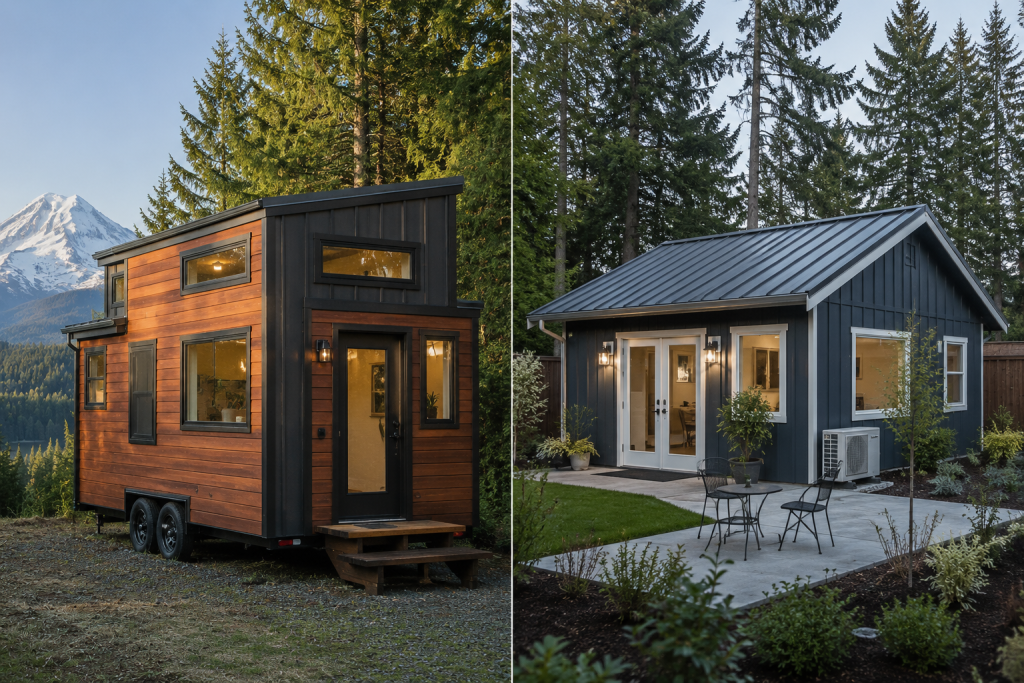
Placing a tiny home in your backyard is highly feasible across many Washington cities and counties, particularly through the ADU pathway. This legal framework has become one of the most straightforward and reliable options available for local property owners.
When tiny homes can be used as ADUs
To qualify for this option, your property must already feature an existing primary residence on the lot. Additionally, local zoning must permit detached ADUs, which is now standard in most urban areas. The lot itself must be large enough to comfortably accommodate local setback rules and coverage limits, while also providing access to shared or independent utility connections.
Common restrictions
Some jurisdictions still impose distinct constraints, including single-story height limits, specific design compatibility rules in historic districts, or strict caps on overall ADU square footage. Furthermore, while state law now mandates that up to two ADUs are allowed per urban lot, several counties are still actively updating their local municipal codes to fully reflect these changes.
Questions to ask your local planning department
Before breaking ground or buying a structure, contact your local planning department and ask these key questions:
- Is my specific parcel zoned to allow a detached ADU?
- What are the exact setback distances and maximum lot coverage requirements?
- Are there any height limits or mandatory architectural design restrictions?
- What specific permits are required, and what are their associated fees and processing timelines?
- Does a Tiny House on Wheels (THOW) legally qualify as an ADU in this jurisdiction?
Tiny House vs. ADU in Washington State
Both can serve as permanent residences; both require permits and utility connections; both are subject to local zoning rules; and both can be detached structures on a residential lot.
| Tiny House | ADU | |
| Size | 400 sq ft max (IRC Appendix Q) | Up to 800-1,200 sq ft (varies by jurisdiction) |
| Primary use | Can be primary or secondary dwelling | By definition, secondary to a primary residence |
| On wheels option | Yes (as THOW) | Generally no |
| Financing | Varies by type | Standard residential financing if on foundation |
What to Check Before Buying Land for a Tiny House
Verify zoning first
Use your county assessor’s GIS map or contact the planning department directly. Confirm the parcel’s zoning designation and whether tiny homes, as primary dwellings or ADUs, are explicitly permitted, conditionally permitted, or prohibited.
Confirm water, sewer, and septic access
Ask whether the parcel has municipal water and sewer connections, or whether you’ll need a well and septic system. Get a percolation test done on rural land before purchase. A failed perc test can make a parcel effectively unbuildable.
Understand site access requirements
County roads may require an approved access permit. Fire departments often mandate minimum driveway widths (typically 12-20 feet) and turnaround clearances for emergency vehicles.
Review easements and property restrictions
Title reports reveal utility easements, access rights, and deed restrictions that can limit what you build. Confirm whether any HOA CC&Rs on the property have been updated to reflect Washington’s post-2023 ADU protections.
Common Challenges Tiny Home Owners Face
Utility connections
Rural utility installs are the biggest budget wildcard. A well plus septic system can run $10,000-$30,000 depending on soil conditions, depth, and local requirements. Municipal connections in urban areas are simpler but come with their own hookup fees.
Permitting delays
L&I plan reviews for off-site builds can take several months due to high demand. Budget time accordingly and don’t order a factory-built unit until you’ve confirmed local placement approval.
HOA restrictions
While post-2023 state law prohibits HOAs from banning ADUs via CC&Rs, some HOAs may dispute the interpretation. Consult a land use attorney if you encounter resistance.
Financing and insurance considerations
Foundation tiny homes qualify for standard Fannie Mae mortgages. THOWs typically use RV financing at 5-15% interest rates or personal loans. Specialty insurers handle non-traditional builds, with homeowner’s policies running $800-$1,500 per year for foundation units and $500-$1,000 for THOW coverage.
Conclusion
Washington State offers more pathways to legal tiny home living than almost anywhere else in the country. The legislative framework is solid, local governments are increasingly supportive, and established communities prove the model works at scale. Understanding where can you put a tiny house in Washington State requires looking at four distinct environments: private residential property, urban ADU pathways, dedicated villages, and flexible rural lots.
However, regulations vary significantly from one county to the next, and what’s allowed in Seattle isn’t automatically permitted in Klickitat County or Pacific County. The most expensive mistake tiny home buyers make is purchasing land or a unit before confirming local placement rules.