

Home builder vs general contractor is a common comparison for anyone starting a construction project. While both professionals play key roles in building and renovation, their expertise and responsibilities differ. A home builder typically focuses on constructing new homes, often managing the entire process from planning to completion.
On the other hand, a general contractor is usually hired for remodeling or specific projects, coordinating subcontractors and ensuring the work follows the design and regulations. Understanding the difference between a home builder and a general contractor helps you choose the right professional for your needs, saving time, money, and effort.
The Difference Between a Builder and a General Contractor
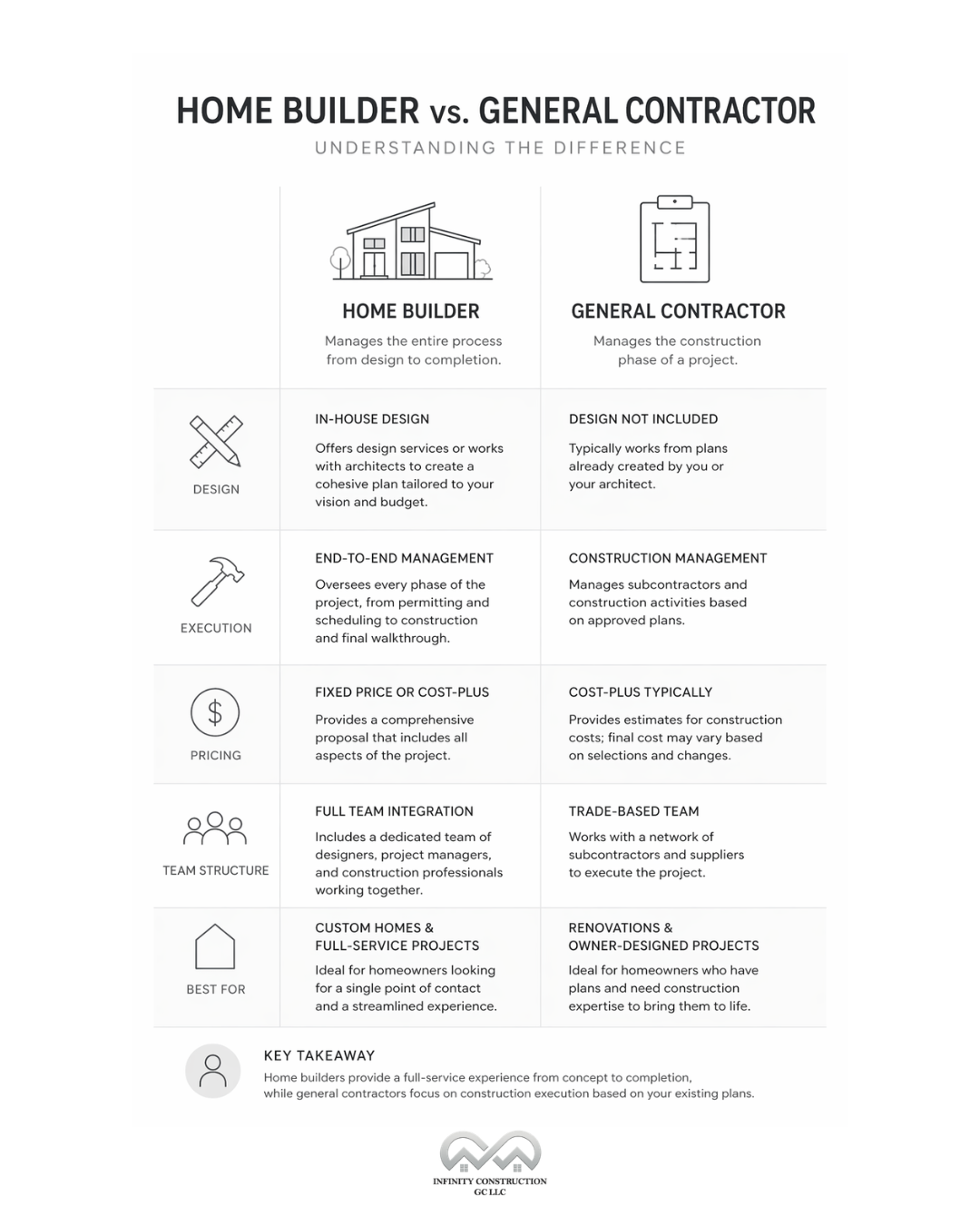
What Is a Home Builder?
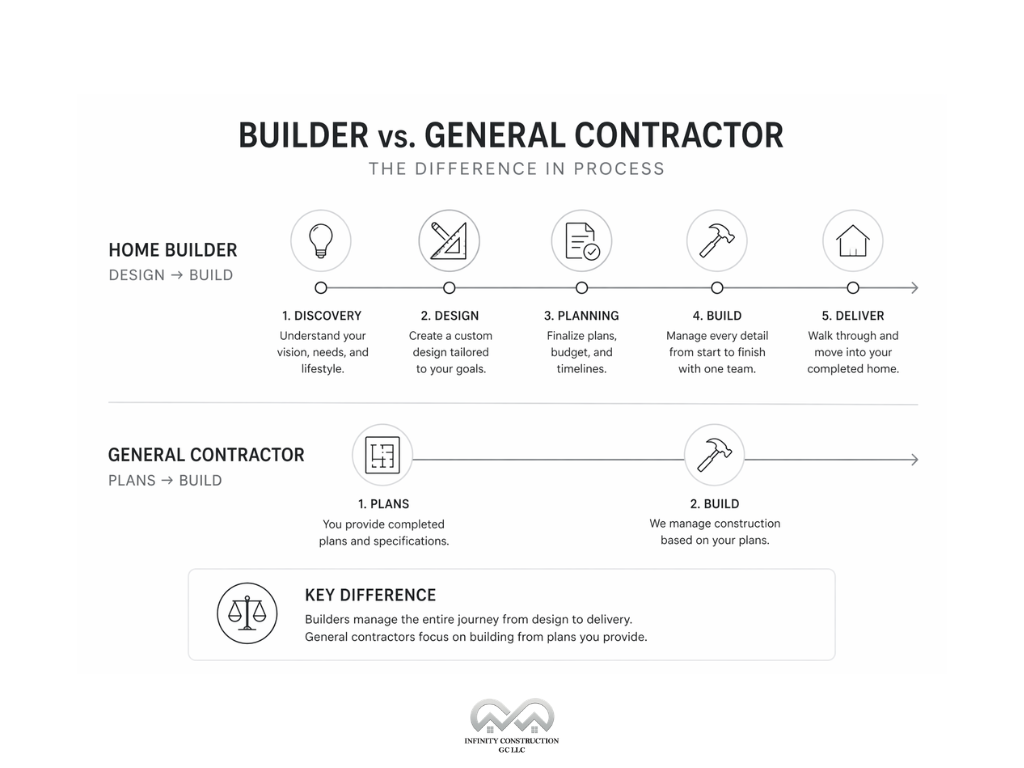
If you are still comparing custom and spec homes, that decision should come before choosing the professional who will manage the build. They’re involved from the very beginning: helping you choose or design a floor plan, selecting finishes, coordinating architectural plans, securing permits, managing inspections, and overseeing the full build through to completion. Most home builders maintain an in-house team for the majority of trades and only subcontract work that requires specialized licensing, such as electrical or plumbing.
What Is a General Contractor?
A general contractor (GC) is a construction professional who manages and executes a project based on pre-existing plans. Think of them as the conductor of an orchestra — they don’t play every instrument, but they make sure all the musicians (subcontractors) show up on time, stay in tune, and deliver the right result. GCs handle everything from pulling permits and scheduling trades to managing budgets and timelines. Their strength is in execution and coordination, not design or early-stage planning.
Why This Decision Matters More Than You Think
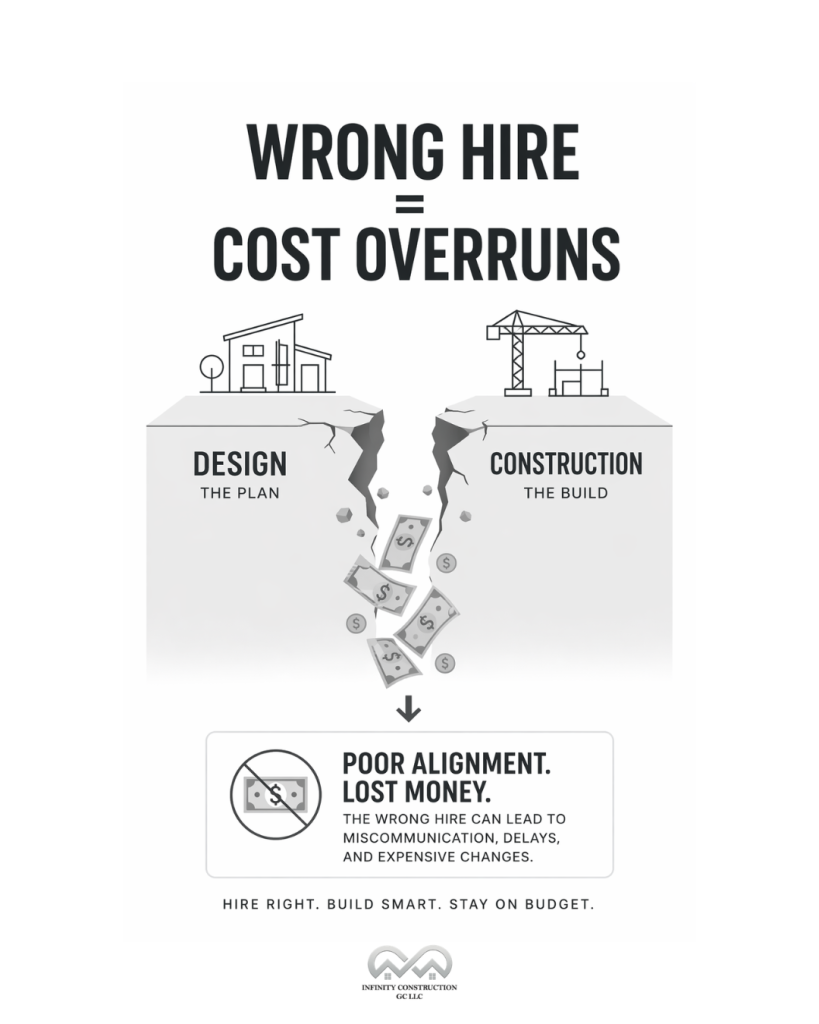
Choosing the wrong professional isn’t just an inconvenience; it’s a financial risk. According to the National Association of Home Builders (NAHB), cost overruns on residential projects frequently stem from poor planning and coordination failures in the early stages. When design and construction are misaligned, you end up with change orders, which are expensive.
A widely cited principle among residential construction consultants and the number one driver of budget blowouts is misalignment between the design and execution phases. When those two aren’t handled by the same team, the gaps are where the money disappears.
Hiring a GC when you needed a builder means scrambling to find an architect separately, managing multiple vendors yourself, and making critical structural decisions without expert guidance. Hiring a builder when a GC would’ve sufficed means potentially overpaying for services you didn’t need. The key is matching the professional to the project stage.
What a Custom Home Builder Really Does
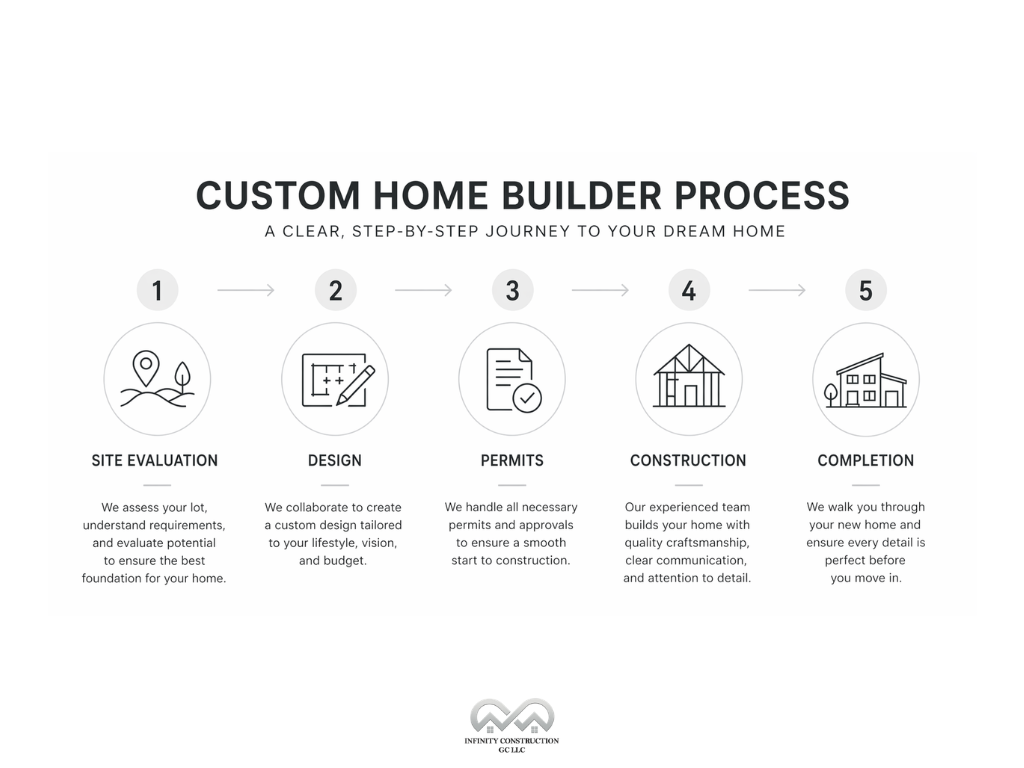
A custom home builder doesn’t just build, they guide you through a complex, multi-phase process that most homeowners have never navigated before. Here’s what that actually looks like:
- Site evaluation and land assessment before a single plan is drawn
- Design collaboration – working with you (and often in-house architects or designers) to create a floor plan that fits your lifestyle, budget, lot, and current design priorities
- Structural planning and buildability review – catching design problems before they become construction problems
- Permit acquisition and code compliance across all relevant jurisdictions
- Day-to-day construction management with a consistent in-house team
- Finish selection guidance – materials, fixtures, colors, cabinetry, and more
- Inspections, walkthroughs, and punch-list completion
- Post-move-in support, including warranty coverage on workmanship
Because custom builders maintain a consistent team, rather than assembling a new crew for every job, there’s greater accountability, tighter communication, and fewer surprises during construction. They also tend to offer flat or fixed pricing for the entire project, which makes budgeting significantly more predictable.
What a General Contractor Really Does
General contractors are extraordinarily skilled; they just operate within a different scope of work. Once you hand them a complete set of architectural drawings and a clear project brief, they take over and manage the entire construction process. Their core responsibilities include:
- Reviewing plans and identifying potential construction challenges
- Hiring, scheduling, and paying specialized subcontractors (electricians, plumbers, framers, roofers, etc.)
- Pulling the necessary building permits
- Keeping the project on schedule and within budget
- Serving as your single point of contact during the build phase
- Ensuring all work meets local building codes and inspection standards
One genuine advantage GCs hold is that they work across many different project types and don’t maintain a locked-in team, they often have broader access to specialized subcontractors. According to HomeAdvisor, general contractors typically charge a 10-20% management fee on top of subcontractor costs. For large projects, that adds up quickly, though that percentage includes substantial coordination value.
The Biggest Mistake – Hiring the Wrong Role at the Wrong Time
The most costly error in home construction isn’t a bad material choice or a delayed delivery. It’s a timing mismatch, bringing in the wrong professional at the wrong project phase.
Scenario of hiring a GC too early
You buy land, have a rough idea of what you want, and immediately hire a general contractor to “get things moving”. The GC tells you they need complete architectural drawings before they can start. You scramble to find an architect, spend months going back and forth on plans, and realize the GC has no real input on whether your design is even buildable on your specific lot. By the time construction starts, you’ve already eaten through contingency funds on planning-phase costs the builder would have covered.
Scenario of hiring a builder when you have complete plans
You’ve already worked with an architect, have a permit-ready set of drawings, and just need someone to execute. Hiring a custom home builder in this case may mean paying for design services and in-house coordination you don’t need, potentially at a premium. A well-vetted GC could execute your plans efficiently and at a lower overall cost.
Timing isn’t just logistical, it’s financial. The right professional at the right phase is how projects stay on budget.
When to Hire a Builder vs a General Contractor
Hire a home builder when
- You’re buying land and starting from zero, and have no plans, no architect yet
- You want a fully custom home designed around your specific lifestyle and needs
- You want one point of contact managing design, construction, and everything in between
- You want predictable, fixed-price contracts with minimal change order risk
- You’re building on a complex or unique site that requires early buildability assessment
- You want long-term warranty support and an ongoing relationship after move-in
Hire a general contractor when
- You already have complete, architect-approved plans ready to build
- You’re remodeling, adding an addition, or renovating an existing structure
- The project is straightforward and doesn’t require custom design services
- You need access to a wider pool of specialized trade contractors
- You’re comfortable managing the design phase independently
- Your build is commercial, mixed-use, or non-residential
Builder vs General Contractor Cost – What Actually Changes
Cost is where many homeowners make assumptions that come back to haunt them. Here’s how the economics actually break down.
Home builder pricing
Home builders typically offer fixed or cost-plus contracts for the entire project. A fixed contract means you know your number upfront with a clear scope. Cost-plus means you pay actual costs plus a predetermined builder margin, typically 15-25%. Either way, there would be one invoice, one relationship, and built-in accountability for the full scope.
General contractor pricing
GCs usually charge 10-20% of total construction costs as their management fee, layered on top of subcontractor and material costs. On a $500,000 project, that’s $50,000-$100,000 in GC fees before a single subcontractor is paid. That’s not necessarily poor value, but it’s important to understand the structure before you commit.
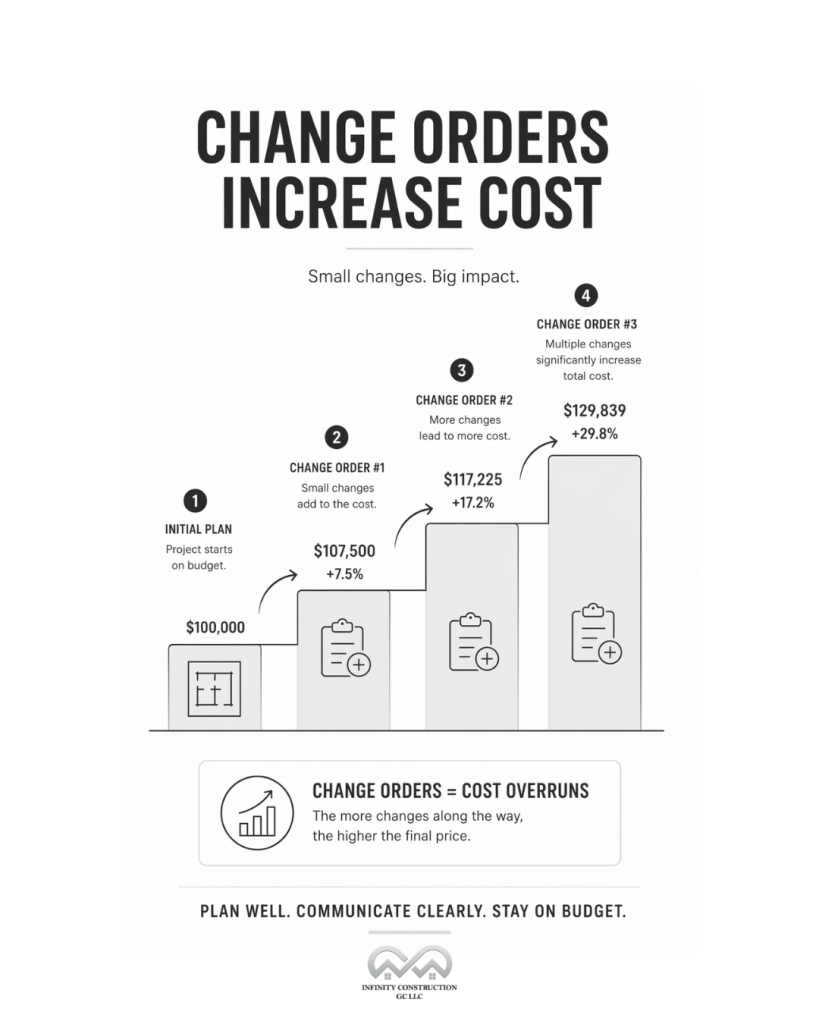
The hidden cost – Change orders
When a home builder is involved from the design phase, structural and design decisions are resolved before construction begins, dramatically reducing expensive mid-build changes. When a GC is handed incomplete or under-reviewed plans, every design gap becomes a change order. Industry data consistently shows that change orders are among the top five causes of residential construction budget overruns.
Coordination inefficiency
If you hire a GC without complete plans, you’ll often end up paying three separate professionals, such as an architect, a designer, and the GC, to coordinate with each other. That coordination cost in time, money, and miscommunication risk is exactly what a home builder eliminates by handling it all in-house.
Quick Comparison Table
| Factor | Home Builder | General Contractor |
| Design Involvement | From day one | After plans are complete |
| Project Scope | New custom homes | Renovations, additions, new builds |
| Pricing Model | Flat / fixed price | % of total project cost |
| Team Structure | In-house + select subs | Primarily subcontractors |
| Design Services | Yes, full guidance | No, bring your own plans |
| Best For | Ground-up custom homes | Renovations & pre-designed builds |
| Long-Term Support | Often yes (warranties) | Typically ends at completion |
| Subcontractor Flexibility | Consistent network | Broader market access |
Real-World Scenarios: Which One Fits Your Project
Scenario 1: Custom home from scratch
Situation: You own a lot in a suburban neighborhood. You want four bedrooms, a chef’s kitchen, a home office, and a covered outdoor living space. You don’t have plans yet.
Answer: Home Builder. A custom home builder will walk your lot, assess site conditions, help you design a plan that works within your budget, coordinate architectural drawings, pull permits, and manage the full build. Trying to piece this together with a GC, a separate architect plus a separate designer adds cost, communication risk, and timeline uncertainty.
Scenario 2: Kitchen remodel or home addition
Situation: You own your home and want to add a 600-square-foot addition and gut-renovate your kitchen. You’ve already worked with an architect and have permit-ready drawings.
Answer: General Contractor. This is exactly what GCs do best. The plans exist, the scope is defined, and what you need is expert coordination of multiple trades to execute efficiently. A well-vetted local GC with strong subcontractor relationships will deliver quality results at a fair cost.
Scenario 3: Pre-designed or semi-custom build
Situation: You’re purchasing a home in a planned development where the builder has set floor plans, and you’re choosing finishes within their system.
Answer: Home Builder (development model). In this case, the builder manages multiple homes simultaneously on a pre-planned schedule. You have less design flexibility than a fully custom build, but more efficiency, tighter timelines, and often lower per-square-foot cost.
Why Custom Homes Usually Require a Builder
Building a truly custom home, from site to structure to finish, requires expertise that most general contractors aren’t equipped to provide. It begins with assessing whether your design is feasible for your specific lot. A skilled home builder can determine early on if your concept is physically achievable, taking into account soil conditions, drainage, setbacks, and local codes, helping you avoid costly changes later.
Once feasibility is confirmed, the focus shifts to how the home will actually stand. Custom homes often involve non-standard spans, vaulted ceilings, or open floor plans that require careful structural planning, and experienced home builders make these decisions proactively, not reactively.
With the structure defined, execution becomes the next challenge. Framing, mechanical, electrical, and plumbing need to integrate seamlessly, and when your custom cabinetry, windows, and fixtures have long lead times, only an experienced builder with a consistent team can manage that orchestration without things falling apart.
At its core, success depends on alignment between design and execution. The best custom homes come from teams where designers and builders work closely, either in-house or through strong, established partnerships.
How to Choose the Right Professional
Before you sign anything, review the right questions to ask before hiring and run through this checklist:
- Are you licensed and insured in this state? (Verify independently.)
- Can you provide references from projects similar to mine in scope and budget?
- Who specifically will be on my project, and will that team stay consistent throughout?
- How do you handle change orders, and what’s the process and typical cost?
Do you obtain permits, and how do you manage inspections?
- What does your contract cover, and what are the exclusions?
- What is your current workload, and can you commit to my timeline?
- Do you offer any post-completion warranty or support?
For custom home projects specifically, also ask: “At what phase do you get involved, and can you show me examples of projects where you guided the design from the beginning?”
Conclusion
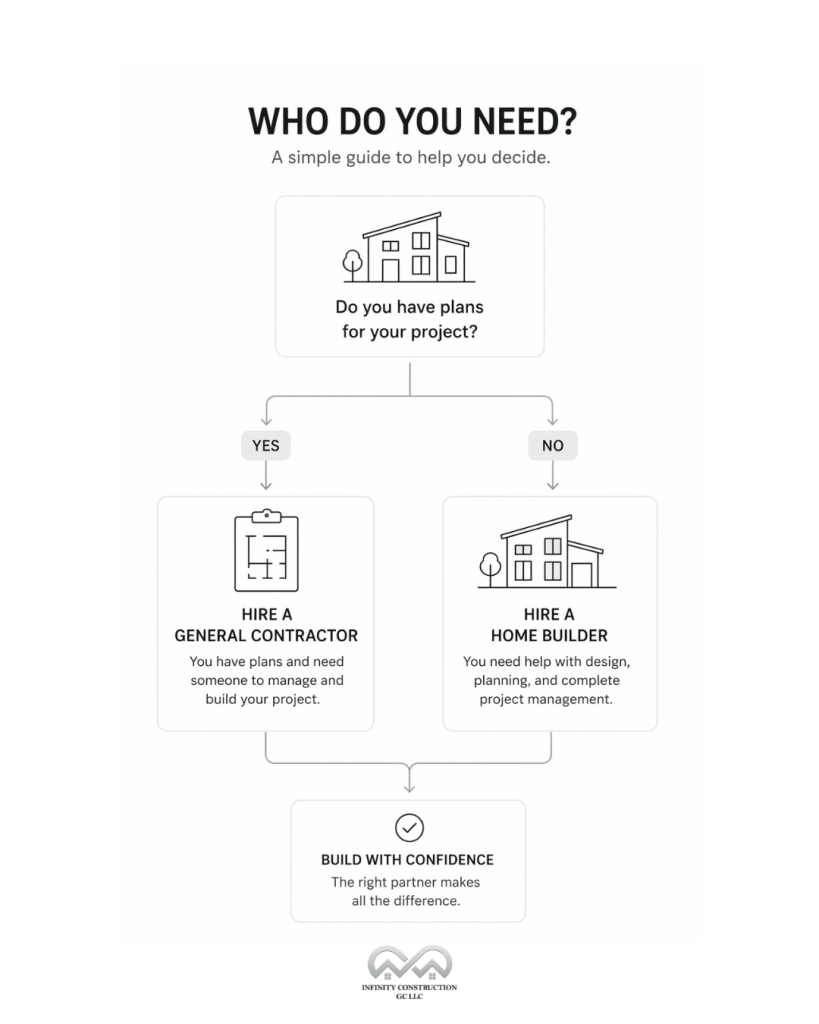
The choice between home builder vs general contractor ultimately comes down to how complete your plans are. If you’re starting without clear plans, a builder is the better fit; if everything is fully designed, a GC can step in efficiently. When your plans are somewhere in between, a builder provides more guidance and protection as details are finalized along the way.
It’s also worth remembering that titles can be misleading, as companies like Infinity Construction GC may support more than one type of construction need. Instead of focusing on labels, ask about their scope, level of involvement, and cost structure before you commit. When building in Washington, getting this decision right sets the tone of the entire project, and it’s likely the single most impactful choice you’ll make throughout the process.