
Whether you’re framing a new home in Tacoma, finishing a basement in Bellevue, or putting up a shop in rural Thurston County, Washington State building codes govern nearly every aspect of your project. Understanding them isn’t just about compliance; it’s about building something that lasts, passes inspection, and protects your investment.
This guide cuts through the jargon and gives you a clear, practical picture of how the Washington State Building Code (WSBC) works, who enforces it, and what it means for your specific project.
How Washington State Building Codes Actually Work
Washington State doesn’t write building codes from scratch. Instead, the state adopts national model codes from the International Code Council (ICC) and amends them under RCW 19.27 to address local seismic risks, climate needs, and energy goals. These state-amended codes establish a mandatory minimum standard that every city and county must enforce.
While local jurisdictions cannot drop below this statewide floor, they can pass stricter local amendments. This creates regional variations, meaning a project in Seattle will face tougher requirements and different design hurdles than one in Eastern Washington. Ultimately, the core code remains identical across the state, but local governments set the final compliance ceiling and handle all permitting and inspections.
Who Sets and Updates Building Codes in Washington State
Washington State Building Code Council (SBCC)
The Washington State Building Code Council is the body responsible for adopting and maintaining building codes statewide. Created under RCW 19.27.070, the SBCC reviews updates to national model codes every three years, develops Washington-specific amendments, and approves or rejects local amendments that affect single- and multi-family residential buildings.
What the SBCC doesn’t do is enforce codes. That’s the local government’s job. Under RCW 19.27.074, any city or county wanting to amend the International Residential Code for single- or multi-family residential buildings must submit that amendment for SBCC approval. Local amendments can be stricter, but they can never reduce the minimum performance standards of the State Building Code.
RCW vs. WAC explained
The Revised Code of Washington (RCW) represents the statutory laws passed by the state legislature. RCW 19.27 establishes the legal framework for building codes, empowers the State Building Code Council (SBCC), mandates local enforcement, and defines policy boundaries. State legislators amend the RCW when changing broader legal policies.
The Washington Administrative Code (WAC) contains the specific regulations that implement those legislative laws. WAC Title 51 houses the technical text, engineering tables, and construction standards that architects and contractors use daily, such as the residential energy code under WAC 51-11R. While the RCW provides the legal authority, job site inspectors cite specific WAC sections for code violations.
The Codes That Make Up the Washington State Building Code
Washington doesn’t have a single document called “The Building Code”. It’s a suite of codes, each covering a different discipline. As of March 15, 2024, the current editions in effect are the 2021 model codes with Washington State amendments.
International Residential Code (IRC)
The IRC governs detached one- and two-family dwellings, adult family homes, and townhouses up to three stories. Under Chapter 51-51 WAC, Washington adopts the 2021 IRC, but deletes Chapters 11 and 25 through 43. Instead, the state officially adopts Appendix AF for radon control, Appendix AQ for tiny houses, and Appendix AWU for dwelling unit fire sprinkler systems.
Assuming the IRC covers an entire residential project causes major permitting bottlenecks. Energy compliance is governed by the Washington State Energy Code (Chapter 51-11R WAC), while plumbing must comply with the Uniform Plumbing Code (Chapter 51-56 WAC). Furthermore, electrical work bypasses local building departments entirely, requiring independent permitting and inspection under the National Electrical Code administered by the Washington Department of Labor & Industries.
International Building Code (IBC)
Once a project steps outside the IRC’s scope, be it multifamily (3+ units), commercial, mixed-use, or certain ADU configurations, it falls under the International Building Code (IBC). The IBC governs occupancy classifications, fire ratings, egress requirements, accessibility standards (ICC/ANSI A117.1), and structural design for larger buildings.
ADU projects frequently surprise owners when they trigger an IBC review rather than an IRC review, especially detached ADUs over 800 square feet or ADUs within mixed-use structures.
Energy, mechanical, plumbing, and fire codes
- Washington State Energy Code (WSEC) – Stringent state-specific regulations for commercial (WAC 51-11C) and residential (WAC 51-11R) efficiency, impacting insulation, windows, HVAC, and lighting.
- International Mechanical Code (IMC) – Governs HVAC, duct design, and exhaust systems, incorporating the International Fuel Gas Code and NFPA standards.
- Uniform Plumbing Code (UPC) – IAPMO-published code regulating plumbing systems, adopted with Appendices A, B, I, and M.
- International Fire Code (IFC) – Regulates fire prevention and safety systems, with specific Washington state exemptions for religious institutions.
Statewide Codes vs. Local Amendments
What local jurisdictions are allowed to change
Local governments have real flexibility, but within limits. They can add requirements and adopt stricter standards. What they cannot do is reduce the minimum performance standards set by the State Building Code. For residential amendments affecting single- or multi-family buildings, SBCC approval is required before a local amendment takes effect.
How it plays out across Washington
King County vs. Pierce County
Both enforce the 2021 codes, but permit review timelines, fee structures, and pre-application processes that differ meaningfully. King County’s unincorporated areas carry additional storm-water and critical areas overlay requirements that can significantly affect site design. Pierce County has its own shoreline ordinances that interact with building permits on waterfront properties.
Seattle vs. Tacoma vs. Bellevue
The core code is identical in all three. Seattle has one of the most robust online permitting systems in the state and has added local green building incentives. Tacoma has invested in streamlined commercial permit pathways. Bellevue is known for thorough plan review, expecting detailed correction letters, but reliable timelines once you’re in the queue.
Rural vs. urban enforcement
In rural counties like Lincoln and Chelan, building departments are smaller, which can mean longer review times during busy seasons, but also more direct staff access. Don’t assume rural means lax; the code requirements are identical statewide.
Building Permits in Washington State
Building permits are required for nearly all construction activity in Washington, and the list is broader than most homeowners expect:
- New construction of any structure
- Additions to existing buildings
- Remodels affecting structural elements, egress, or building systems
- Decks (even ground-level, depending on jurisdiction)
- Detached garages, barns, and agricultural structures over certain thresholds
- Steel buildings and prefab structures
- Mechanical, plumbing, and electrical work (often separate permits)
Homeowners risk severe legal liability and voided insurance coverage by skipping permits for finished basements, garage conversions, or added bathrooms. Separate trade applications are standard, requiring independent routing through municipal review portals.
However, state housing laws RCW 35.21.990 and RCW 35A.21.440 strictly prohibit cities from requiring restrictive change-of-use permits when converting existing commercial or mixed-use buildings into residential housing to accelerate urban density.
The Washington State Building Permit Process (Step-By-Step)
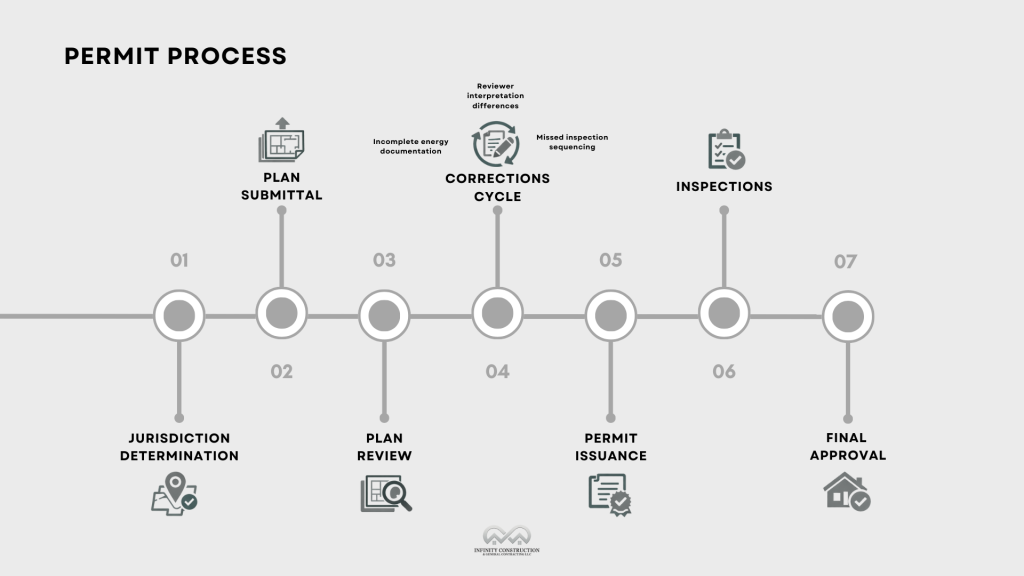
1. Jurisdiction determination
Confirm which jurisdiction has authority over your parcel. Unincorporated land falls under county jurisdiction; incorporated areas fall under city jurisdiction. Verify with the county assessor or GIS tools before doing anything else.
2. Pre-application conference
Many jurisdictions offer pre-application meetings, especially for complex projects. Use them. This is where you identify code conflicts and site constraints before spending money on full construction drawings.
3. Plan submittal
Submit complete drawings, energy compliance documentation, and required engineering calculations. Most jurisdictions now require digital submittals. Incomplete submittals are the single biggest cause of project delays.
4. Plan review
Reviewers check your documents against applicable codes. Expect separate reviews for structural, energy, mechanical, plumbing, and fire, depending on project scope. First-review timelines range from two weeks to several months in high-volume counties.
5. Corrections
Nearly every project receives a correction letter. Respond completely; partial responses extend review time. Common flags include energy compliance documentation gaps, egress window sizing, structural connection details, and mechanical coordination.
6. Permit issuance
Once approved, pay fees and receive your permit. Post it visibly on the site before work begins.
7. Inspections
Inspections occur at defined stages: footing, framing, rough mechanical/plumbing/electrical, insulation, and final. Do not cover work before it’s inspected. Inspectors cannot approve what they can’t see, and calling for re-inspection after covering work adds cost and delay.
8. Certificate of occupancy
Once all inspections pass, you receive final approval. For new construction, this is your Certificate of Occupancy (CO) – the legal document confirming the building is safe for occupancy.
Where project delays most often occur: incomplete submittals, deferred energy compliance documentation, and failing to schedule inspections before covering work.
Special Code Considerations in Washington State
Wildland-Urban Interface (WUI) Areas
Washington’s WUI Code applies in designated high fire-hazard zones, and the map is actively expanding. As of early 2024, the SBCC rescinded portions of the 2021 WUI Code via emergency rule while awaiting completion of statewide wildfire risk mapping by the Department of Natural Resources (DNR). WUI Code amendments are currently in “Reserved” status pending that mapping.
For builders, the WUI designation for a given parcel is in flux. Before designing any rural or semi-rural project, verify the current WUI status with your local jurisdiction. When WUI applies, it triggers requirements for ignition-resistant construction, ember-resistant vents, and defensible space that meaningfully affect both design and material costs.
Seismic and environmental requirements
Washington sits above the Cascadia Subduction Zone, one of the most seismically active regions in North America. Seismic Design Categories (SDC) here are generally higher than the national average, meaning stricter requirements for lateral force resistance. Foundation design, anchor bolt requirements, and shear wall specifications are all calibrated to Washington’s seismic risk profile.
Recent legislation has also created new allowances for energy-efficient construction:
- RCW 36.70A.810 – Allows exterior insulation retrofits to encroach up to eight inches into setbacks
- RCW 36.70A.812 – Adjusts local zoning rules to accommodate passive house construction methods
- RCW 36.70A.813 – Mandates up to 48-inch roof height overages for solar panel installations
Pre-approved plans and expedited reviews
Several Washington jurisdictions have created programs to streamline permits for common project types. King County, Pierce County, and Kittitas County allow applicants to submit a “base plan” that, once approved, stays on file, and future projects using the same plan receive faster review and reduced fees.
For ADUs specifically, cities like Lacey and Renton offer pre-approved plan libraries that dramatically reduce review time for homeowners who select from approved designs rather than submitting custom drawings. Expedited review programs exist in Covington, Kirkland, Tacoma, and Skagit County, typically available for a fee or tied to participation in green building programs.
Where to Find Official Washington State Building Code Resources
- sbcc.wa.gov – Adopted codes, amendments, interpretations, and adoption cycle updates
- codes.iccsafe.org – Free online access to ICC model codes, including 2021 IBC, IRC, IMC, and IFC
- epubs.iapmo.org – Free online access to the 2021 Uniform Plumbing Code
- mrsc.org – Plain-language guidance on Washington permit processes and local government compliance
- lni.wa.gov – Department of Labor & Industries; electrical permits and inspections statewide
Code interpretation requires specialized expertise. Two inspectors in separate jurisdictions can read the exact same International Residential Code (IRC) section differently. When technical uncertainties arise, a pre-application meeting with your local building department provides a definitive local ruling that overrides any online resource.
Conclusion
Washington State building codes exist to protect people by ensuring structures withstand local seismic activity, extreme weather, and fire hazards. This mission relies on a layered system combining national ICC model codes, state-specific amendments, and localized municipal enforcement.
Navigating the regulatory landscape successfully depends on understanding this administrative framework well enough to engage with local officials, ask technical questions, and address compliance constraints early in the design process.