

Building a custom home is often seen as a straightforward process – design the plans, hire a builder, and start construction. But in reality, it’s a multi-phase journey that stretches far beyond the visible work on site.
From initial concepts and architectural drawings to permits, selections, coordination, and key decisions, much of the timeline is shaped before construction even begins. So, what makes the process unpredictable isn’t the construction itself, but everything around it. These factors can quietly extend the schedule in ways that aren’t obvious at the start.
The key to accurately estimating how long does it take to build a custom home lies in recognizing what truly drives the schedule. If you’re planning a custom home build, or even just exploring the idea, this guide will reset your expectations and save you from costly surprises.
How Long Does It Take to Build a Custom Home – Timeline
Building a custom home from start to finish generally takes 12 to 24 months. However, for complex or high-end projects, it may take 18 to 36 months, covering the entire process from initial design and land acquisition through permitting, construction, and final finishes.
According to data from the U.S. Census Bureau Survey of Construction, owner-built and fully custom homes consistently take significantly longer than production homes, and that gap widens as design complexity increases. A true custom home has three distinct phases, and what happens in each directly shapes how long you’ll have to wait to move in.
| Phase | Typical Duration |
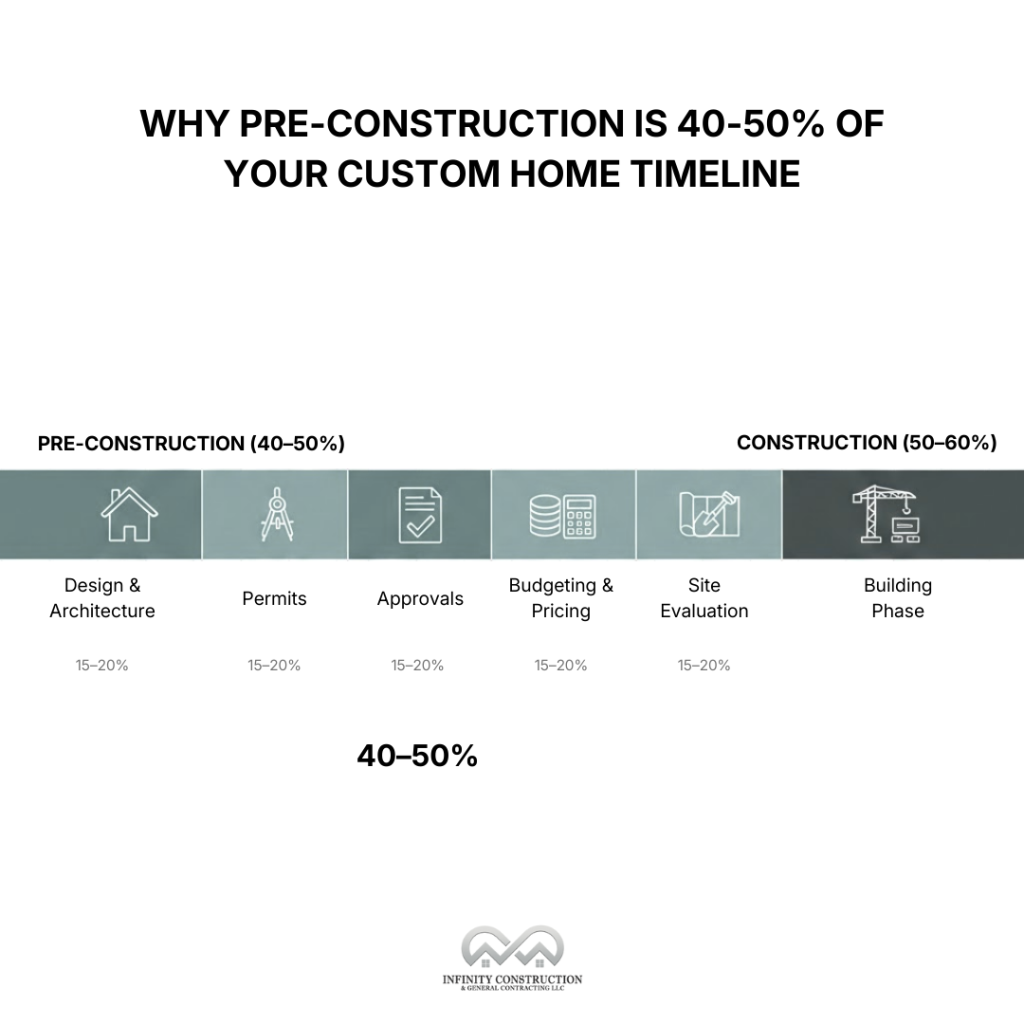
| Pre-construction (planning, design, permits) | 6–12 months |
| Construction (groundbreaking to completion) | 10–18 months |
| Final inspections & move-in | 2–6 weeks |
Phase 1. Pre-construction (6-12 months)
The pre-construction phase is the phase most timelines underestimate and the most expensive one to rush. Design decisions, budget alignment, and permitting all happen here. Skip steps or move too fast, and the problems don’t disappear. They show up later, mid-construction, where fixing them costs far more in both time and money.
Site selection or evaluation (1-3 months)
Before a single line gets drawn, site evaluation needs to confirm zoning compliance, setbacks, utility access, slope, soil conditions, and environmental constraints. A lot that looks perfect can carry hidden complications, soil requiring special foundations, flood zone designations, or missing utility connections, that reshape both cost and time before construction ever begins.
The most common pitfall here is skipping due diligence in favor of momentum. Falling in love with a property before properly evaluating it doesn’t speed things up; it defers problems to a stage where they’re far more expensive to solve.
Architectural design (4-8 months)
Design unfolds in four sequential stages: predesign and feasibility, schematic design, design development, and construction documents. Each phase requires review and sign-off before the next begins, which is why this stage alone can take six months or more for fully custom homes. Rushing any phase doesn’t compress the timeline; it creates gaps that surface later as change orders and schedule disruptions.
The most expensive mistake here is treating design as a formality rather than the foundation of the entire build. Errors or ambiguities in construction documents don’t stay on paper, but they show up on the job site, where fixing them costs significantly more in both time and money.
Budget alignment and pricing (1-3 months)
Once the design reaches sufficient detail, it needs to be priced, and that process involves breaking down every system, finish, and structural element into line items, then calibrating those numbers against your actual budget. This is where value engineering happens, adjusting the design to bring costs in line without compromising the overall vision.
The most common pitfall is completing a full set of drawings before involving a builder in the pricing conversation. Discovering the home as designed is significantly over budget at that stage doesn’t just hurt financially; it sets the entire timeline back by months while the design gets reworked.
Permitting and approvals (1-6+ months)
Once the construction documents are complete, they enter permitting and approvals with the local municipality for review. Timelines here vary dramatically because some jurisdictions issue permits in weeks, others take six months or more, particularly in areas with complex zoning overlays, coastal regulations, or active HOA (Homeowners Association) review boards. This is the phase homeowners have the least control over, so preparation before submission is critical.
The most avoidable delay at this stage is submitting incomplete or inconsistent documents. Reviewers will flag them, request revisions, and send the process back to your architect, adding weeks or months to a wait you can’t otherwise shorten. Submitting clean, fully coordinated drawings the first time is the single most effective way to keep this phase moving.
Phase 2. Construction (10-18 months)
Once permits are issued and plans are finalized, visible work like framing and exterior shell construction finally begins. But even at this stage, timelines don’t stay predictable. Labor availability, material lead times, site conditions, and late decisions can all shift the schedule, even on a well-planned project.
Site prep and foundation (1-2 months)
Before any vertical construction begins, the site needs to be cleared, graded, and prepared to support the structure. This includes excavation, installing drainage systems, and pouring the foundation, whether that’s a slab, crawl space, or full basement. The foundation is the most structurally critical element of the entire build, and the time invested here directly affects everything built on top of it.
The most common pitfall at this stage is unexpected soil or site conditions that weren’t fully identified during pre-construction. Poor soil bearing capacity, unexpected rock, or high water tables can require engineered foundation solutions that add both cost and time. This is another reason a thorough site evaluation in Phase 1 isn’t optional.
Framing and exterior shell (2-4 months)
Wood framing is when the home first starts to look like a home: walls go up, the roof takes shape, and the footprint becomes real. Once framing is complete, the exterior shell is closed in with sheathing, roofing, windows, and doors. This “dried-in” milestone is significant because it protects the interior from weather and allows interior work to begin regardless of conditions outside.
The most common pitfall here is design complexity. Custom rooflines, large window packages, or intricate structural details all extend framing time. Material lead times for windows and doors, which can run 8-16 weeks for custom units, can also stall progress if orders weren’t placed well in advance during pre-construction.
Rough mechanicals – HVAC, plumbing, electrical (1-2 months)
With the frame up and the shell closed, the mechanical trades move into roughing in the home’s core systems. HVAC ductwork, plumbing supply and drain lines, and electrical wiring all get run through walls, floors, and ceilings before anything is covered up. This phase requires careful coordination between trades, as each system competes for the same space inside walls and above ceilings.
The most common pitfall is poor trade sequencing. When plumbers, electricians, and HVAC contractors aren’t properly coordinated, conflicts arise because one trade’s work blocks another’s, requiring tear-out and rework. A builder who actively manages trade scheduling rather than just booking them sequentially can shave weeks off this phase.
Insulation and drywall (1-1.5 months)
Once rough mechanicals pass inspection, insulation is installed, and drywall follows. This phase moves relatively quickly but marks an important psychological and practical shift, as the home transitions from an open frame to finished-looking rooms. Drywall taping, mudding, and sanding require dry conditions and adequate cure time between coats, so humidity and temperature inside the home matter more than most people expect.
The most common pitfall is rushing inspections to get drywall up faster. Rough mechanical inspections must be passed before walls are closed, and skipping or shortcutting this step can result in having to open walls later, which is as disruptive as it sounds.
Interior finishes – Cabinetry, flooring, tile, trim (3-5 months)
Interior work is the longest and most decision-intensive phase of construction. Cabinetry is installed, flooring is laid, tile work is completed, and all interior trim and millwork is fitted. Paint goes on the walls. The home begins to reflect the vision that was on paper for the past year or more. The duration of this phase is almost entirely determined by the complexity and level of customization of the selected finishes.
The most common, and most avoidable, pitfall is selections that haven’t been made or materials that haven’t been ordered by the time this phase begins. Custom cabinetry alone can carry lead times of 10-16 weeks. If selections aren’t locked and materials aren’t on-site when the schedule calls for them, work stops. This is where late decisions from earlier in the project collect their debt.
Final fixtures, inspections, and punch list (1 month)
The final phase brings everything together, with plumbing fixtures, light fixtures, hardware, appliances, and finish details installed. Municipal inspections are scheduled and completed, and a thorough punch list is generated to capture any items that are incomplete or require correction before the certificate of occupancy is issued.
The most common pitfall here is a long punch list, which is almost always a symptom of quality control issues earlier in the build rather than problems that originated in this phase. Builders who conduct regular walkthroughs throughout construction rather than waiting until the end catch issues when they’re still easy to fix, keeping the final punch list short and moving in on schedule.
Phase 3. Final inspections and move-in (2-6 weeks)
After months of construction, Phase 3 is where everything gets formalized. Municipal inspections verify that the home was built to code, the certificate of occupancy is issued once all approvals are in place, and a final walkthrough identifies any remaining items on the punch list that need to be resolved before move-in.
When previous phases have been well-managed, this stretch moves quickly and without drama. When they haven’t, it becomes the stage where overlooked details, incomplete finishes, and deferred decisions finally demand resolution, often at the worst possible time.
What Actually Causes Custom Homes to Take Longer
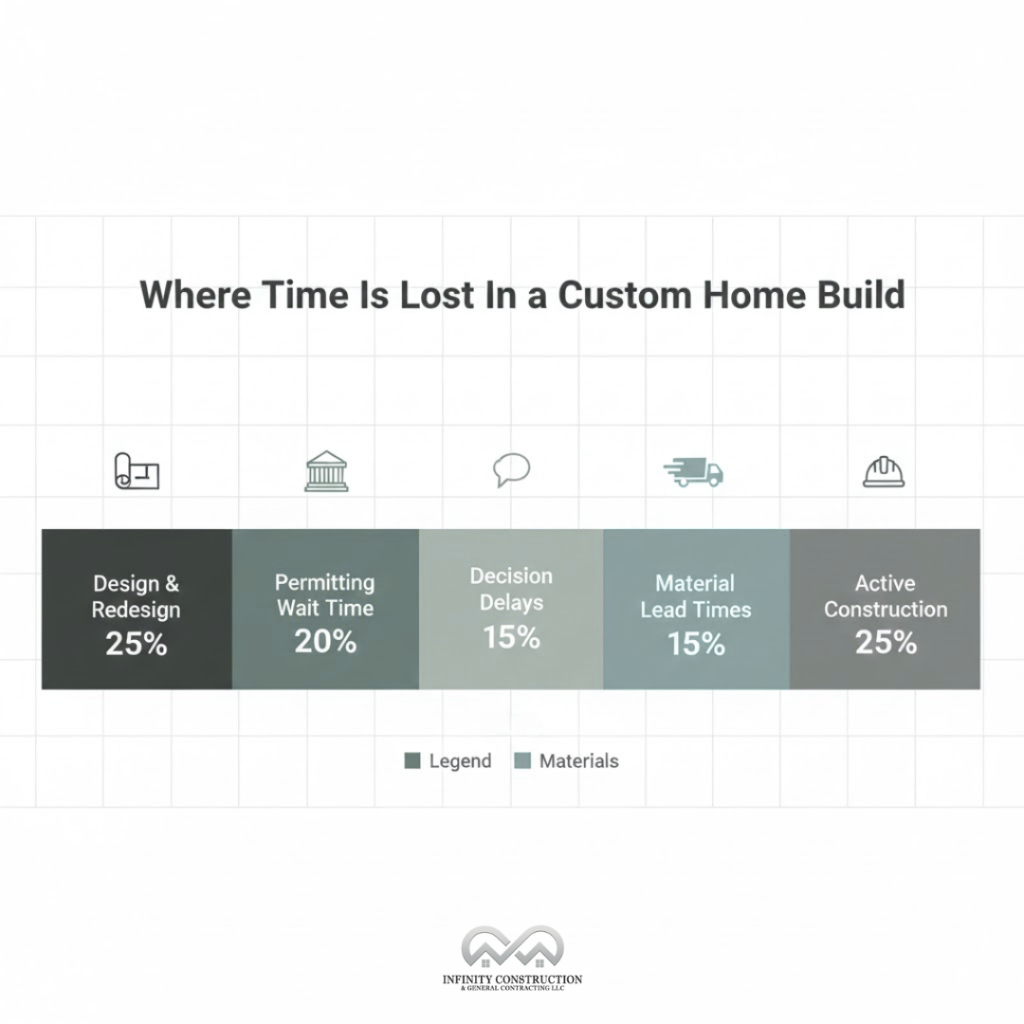
Delays in custom home builds rarely stem from a single dramatic event. They accumulate – small decisions deferred, materials ordered late, changes made after construction starts. Understanding the real culprits before you break ground is the difference between a project that runs on schedule and one that quietly extends for months.
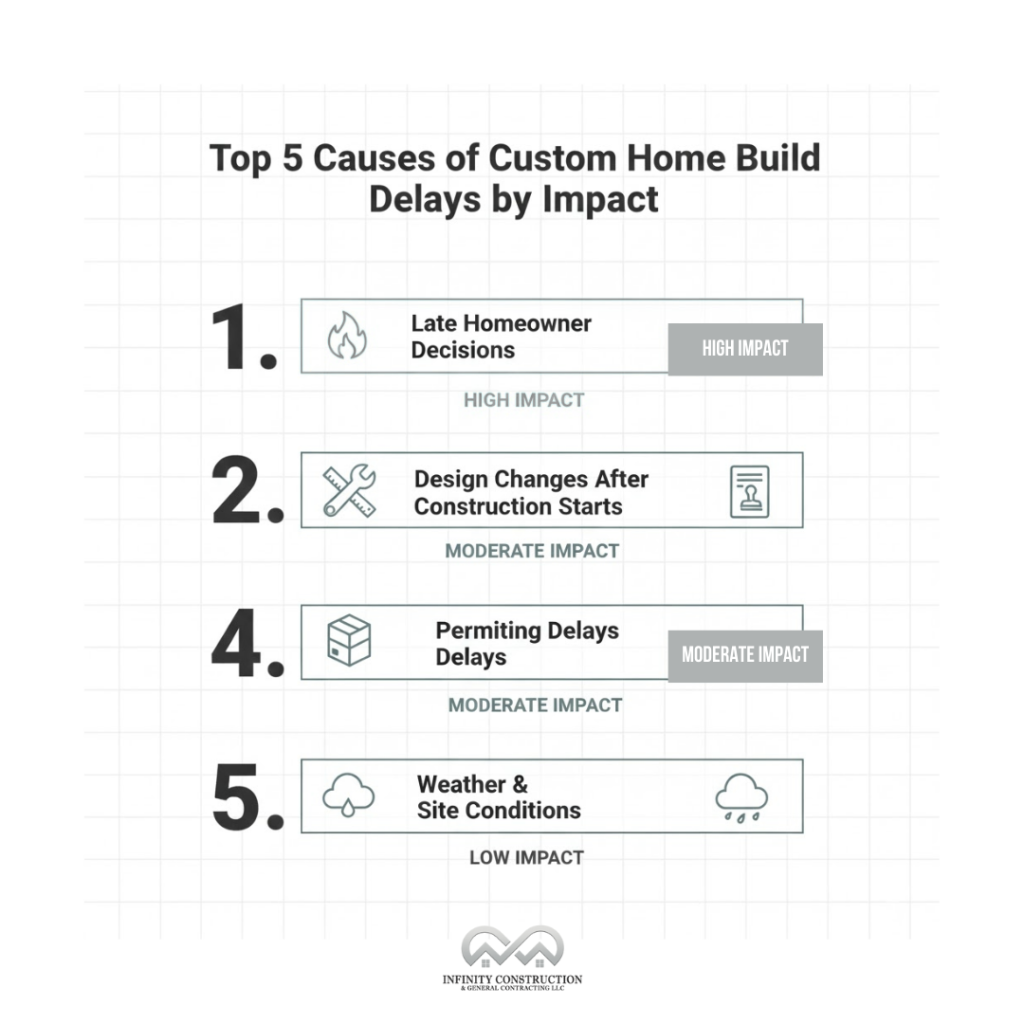
Late decisions (The #1 cause)
Every unresolved choice, including flooring, cabinetry, fixtures, and layouts, creates a bottleneck somewhere downstream. Contractors can’t install what hasn’t been selected. Suppliers can’t order what hasn’t been chosen. And schedulers can’t sequence work around materials that haven’t arrived.
What feels like a small delay in making a decision rarely stays small; it ripples forward through every trade and timeline that depends on it. The rule of thumb is simple: each late decision costs weeks, not days.
Design changes after construction starts
Changing your mind during pre-construction is expected and relatively painless. Changing it after breaking ground is a different situation entirely. A change order mid-build doesn’t just alter one thing; it disrupts the sequencing of everything that was scheduled around the original plan. Structural or layout changes can force work to stop while drawings are revised, permits are updated, and trades are rescheduled. What feels like a minor adjustment can add one to three months to the timeline almost instantly.
Permitting complexity
Permitting is the one phase of the process where speed is largely out of your hands. Local review boards, zoning overlays, coastal or environmental regulations, and HOA approvals all operate on their own timelines, and none of them move faster because you’re in a hurry. What you can control is the quality of your submission. Incomplete or inconsistent documents get flagged, sent back, and resubmitted, turning a four-week review into a four-month one. Preparation is the only leverage you have here.
Material lead times
Custom homes require custom materials, and custom materials don’t ship overnight. Windows, doors, cabinetry, stone, and specialty systems routinely carry lead times of eight to 20 weeks or more. If these items aren’t ordered well in advance, construction doesn’t pause gracefully and wait. It stops. Crews move off your job to other projects, momentum is lost, and getting back on schedule often takes longer than the delay itself.
Weather and site conditions
Weather has the most impact early in the build, during site prep, foundation work, and framing, when the structure is still exposed to the elements. A wet season or an unusually harsh winter can push these phases back by weeks. Once the home is dried in and the exterior shell is closed, weather becomes far less of a factor. Difficult sites, such as steep slopes, unstable soil, and limited access, can extend timelines regardless of the forecast.
How Homeowners Can Protect Their Timeline
If you want control over how long does it takes to build a custom house, these actions matter more than anything else:
- Hire professionals who manage the process, not just construction
- Finalize the design before breaking ground (the biggest factor in avoiding delays)
- Lock selections early, especially windows, doors, cabinetry, and finishes
- Avoid mid-construction changes unless absolutely necessary
- Respond quickly to builder questions and decisions
Custom vs. Semi-Custom vs. Production Homes (Timeline Comparison)
| Home Type | Typical Timeline |
| Production / spec home | 4–6 months |
| Semi-custom home | 8–12 months |
| Fully custom home | 18–24+ months |
Conclusion
Understanding the timeline for building a custom home starts with accepting that there is no fixed schedule, because it depends on how the project is managed. Most builds fall within 12-24 months, while more complex homes often take 18-36 months, with timelines shaped more by planning and decision-making than by construction itself.
The biggest factor isn’t the builder or permits; it’s how quickly and clearly decisions are made. Unresolved design choices and late selections create delays that add up, and flexibility during construction often slows progress. Projects that stay on schedule are those where key decisions are finalized before breaking ground.