

Choosing between wood vs steel framing is one of the most consequential decisions in custom home construction. The frame is the structural backbone of the house, which determines how the building performs, how easily it can be modified, how much it costs to build, and how it ages over time.
Steel framing has gained visibility in recent years due to durability claims, fire resistance, and commercial construction trends. But when you strip away marketing narratives and look at real-world residential construction, wood framing remains the superior choice for most custom homes, especially in regions like Seattle, Bellevue, and Tacoma.
This guide breaks down wood framing vs steel framing honestly and in depth, covering cost, durability, sustainability, performance, and constructability, so homeowners can make informed decisions without sales-driven bias.
What Is Wood Framing and Why Is It Ideal for Custom Homes?
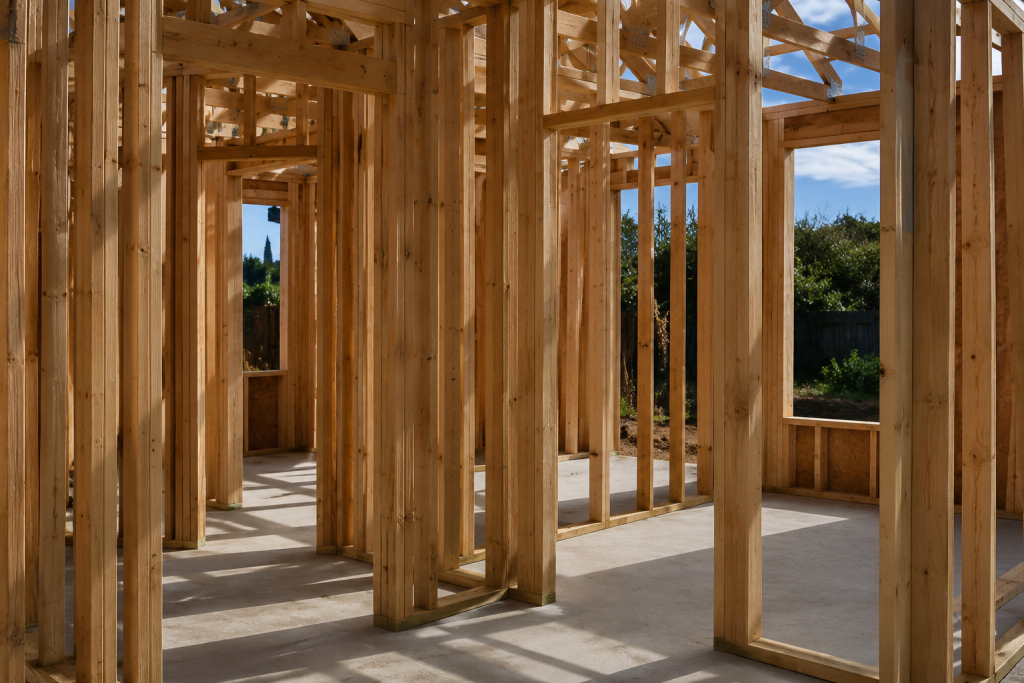
Wood framing, often called stick framing, uses dimensional lumber or engineered wood products to create wall, floor, and roof assemblies. It has been the dominant residential construction method in North America for over a century, and for good reason.
For custom homes, wood framing excels because it balances structural performance, affordability, adaptability, and energy efficiency in a way steel framing simply doesn’t for low-rise residential projects.
In Pacific Northwest climates, wood framing performs particularly well due to several reasons:
- Natural insulation
- Moisture management
- Engineered performance
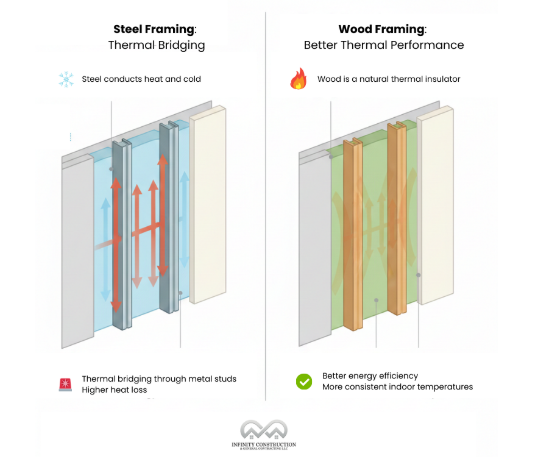
Wood provides natural thermal insulation, helping reduce heat loss and improve energy efficiency. It also allows builders to easily incorporate moisture-management strategies such as rainscreens and ventilated wall assemblies, which are critical in wet climates. Additionally, engineered wood products like LVL, glulam, and CLT enhance strength and dimensional stability while maintaining the flexibility that makes wood framing so adaptable.
Wood framing isn’t just traditional – it’s optimized for residential construction.
Key Benefits of Wood Framing for Custom Homes
Affordability
With regard to whether is steel framing cheaper than wood, the answer is usually no. Wood framing typically costs less upfront due to lower material prices (especially when markets stabilize), faster installation, broader contractor availability, and standard fasteners and tools that don’t require specialized equipment.
When comparing typical custom home averages, the gap becomes clear because wood framing has lower material costs and lower labor costs. Whereas steel framing has higher material costs, higher labor rates, and added insulation detailing.
Steel proponents sometimes argue that long-term savings offset the higher upfront cost, but those claims often ignore the added expense of insulation, more complex detailing, and higher modification and repair costs over time. In practice, steel framing vs wood framing cost consistently favors wood for residential projects.
Design flexibility
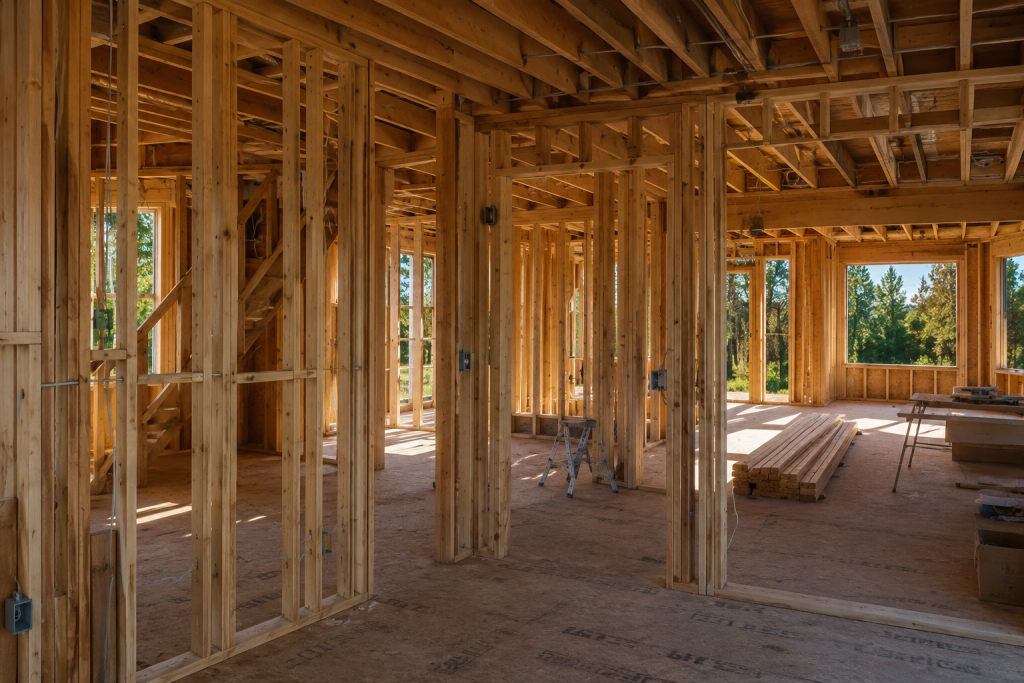
Custom homes change during construction because layouts evolve, openings shift, and details get refined. Wood framing handles this reality better than steel. Wood allows on-site modifications without specialized equipment, easier electrical and plumbing changes, and faster adaptation to client requests.
Steel framing, on the other hand, is precise but rigid. Once assembled, changes are slower, costlier, and require experienced metal framers. For truly custom homes, flexibility matters, and wood wins decisively.
Sustainability
Wood framing is one of the most environmentally responsible structural systems when sourced correctly, as wood is renewable and trees sequester carbon during growth. In addition, wood products require less energy to manufacture than steel, making them a more efficient option overall. Sustainably harvested lumber also supports long-term forest health.
Steel is recyclable, but its production is energy-intensive and carbon-heavy. From a lifecycle perspective, wood framing generally has a lower embodied carbon footprint, especially in residential construction.
Comparing Wood Framing and Steel Framing for Custom Homes
Cost comparison
When analyzing steel framing vs wood framing, cost must be evaluated holistically, and not just at the material level. Wood framing consistently comes out ahead because labor is faster and more widely available, fewer specialized fasteners are required, achieving energy-code compliance is simpler, and repairs down the line are straightforward.
Steel framing, by contrast, introduces costs that compound quickly. Thermal bridging requires continuous exterior insulation, specialized fasteners, and tools, which add to the budget, and the pool of trades familiar with metal framing is smaller, which drives up both labor costs and scheduling risk.
The bottom line is that wood framing is more cost-effective for custom homes, both during construction and throughout ownership.
Durability and maintenance
Modern wood framing is not fragile. Pressure-treated lumber, engineered wood products, and proper moisture management produce structures that last for generations, with proven longevity, easier repairs, and better tolerance of minor construction variability than steel framing typically allows.
Steel offers real durability advantages: it’s non-combustible, termite-resistant, and dimensionally stable. But those benefits come with a maintenance trade-off. In damp or coastal environments, steel requires ongoing corrosion protection, a cost and upkeep burden that wood avoids. When wood does need repair, the work is simpler and cheaper.
Ultimately, durability is about system performance, not just material strength. A well-detailed wood frame outlasts a poorly maintained steel one every time.
Environmental impact
Wood framing has a strong sustainability profile. It’s renewable, carbon-storing, and requires significantly less energy to manufacture than steel, and because it’s often regionally sourced, transportation impacts stay low as well.
Steel, by contrast, is fully recyclable, which counts in its favor. But the manufacturing process generates higher emissions, and the material’s weight typically means a greater transportation impact from the mill to the job site.
For residential projects with sustainability goals, wood aligns more naturally with green building standards and long-term environmental responsibility.
Is Steel Framing Better Than Wood?
Steel’s strength
Steel is undeniably strong, and that strength genuinely matters in the right context. Commercial buildings, multi-story structures, large-span applications, and industrial facilities all benefit from what steel offers. For those use cases, it’s often the right choice.
Residential homes, however, rarely fail because the studs weren’t strong enough. When failures happen, the culprits are poor connections, inadequate shear walls, moisture intrusion, or envelope design flaws, none of which steel’s raw strength does much to prevent. In single-family home construction, that strength advantage largely disappears.
Wood framing’s suitability for residential projects
Wood framing remains the ideal solution for custom homes because it is easier to source locally, efficiently meets residential structural demands, and supports energy-efficient wall assemblies. It also helps keep the costs predictable, aligns well with contractor expertise, and supports energy-efficient wall assemblies.
In residential markets like Seattle, Bellevue, and Tacoma, where moisture control, insulation performance, and customization matter, wood framing consistently outperforms steel in real-world outcomes.
Conclusion
When evaluating wood vs steel framing, it’s tempting to focus on material claims alone. But custom homes demand more than strength – they require flexibility, affordability, energy efficiency, and long-term value, and wood framing delivers all of that.
Wood framing is more cost-effective, easier to modify, better insulated, more sustainable, and backed by a deep residential construction ecosystem that steel simply can’t match. For most custom homes, wood remains the smarter, more practical choice.
If you’re planning a custom home or addition, contact Infinity Construction GC LLC to discuss how expert wood framing can turn your vision into a durable, high-performance home built to last.